
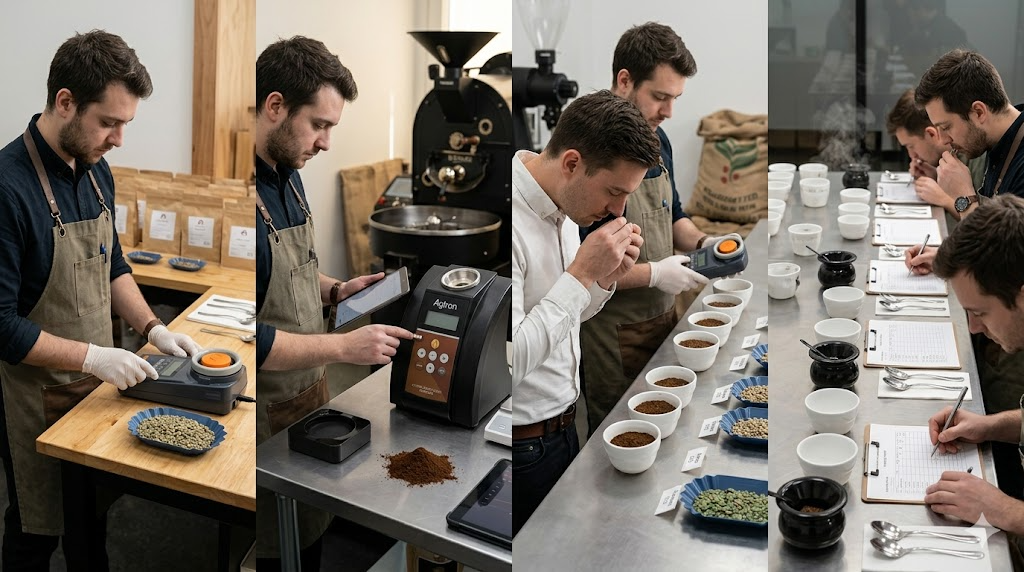
Maintaining consistent coffee quality is essential for specialty roasters, laboratories, and commercial coffee operations. A comprehensive coffee quality control workflow ensures that every batch meets rigorous standards from receiving to final cupping evaluation. By systematically monitoring key parameters such as moisture content, bean size, defects, and flavor profiles, coffee professionals guarantee consistency, reduce waste, and produce premium coffee.
Coffee Pro Direct designs its quality control solutions to integrate precision instruments, lab equipment, and workflow processes that support accurate measurement and reliable results.
The Importance of Coffee Quality Control
Coffee quality control is the backbone of specialty coffee production. Proper evaluation allows roasters to detect defects, assess moisture levels, grade beans, and fine-tune roasting profiles. Consistent quality is crucial for meeting customer expectations, maintaining brand reputation, and ensuring compliance with industry standards. A structured workflow helps identify issues early, minimizing the risk of flawed batches and ensuring that every cup of coffee delivers the intended flavor experience.
Coffee quality control is a structured process that combines physical analysis, roasting tests, and sensory evaluation. Coffee professionals measure parameters such as moisture content, bean density, roast colour, and flavour characteristics to ensure consistency across batches. This systematic approach helps identify defects early and maintain consistent flavour profiles for commercial production.
Receiving and Inspecting Green Coffee Beans
The quality control process begins with the inspection of green coffee beans upon arrival. Beans are visually assessed for defects, irregular sizes, and contamination. Using coffee grading sieves, beans are separated by size to create uniform batches, ensuring that subsequent analysis and roasting are accurate and consistent. A precision inspection at this stage lays the foundation for all quality control measures that follow.
Green Coffee Inspection Benchmarks
| Quality Parameter | Typical Industry Standard |
|---|---|
| Moisture content | 10–12% |
| Water activity | 0.50–0.60 |
| Defect tolerance | ≤ 5 full defects per 300 g |
| Bean size grading | Screen 14–20 |
| Foreign material | <0.5% |
These benchmarks are commonly used in specialty coffee grading to determine whether a lot is suitable for roasting and export evaluation.
Measuring Moisture Content
Moisture content directly affects roasting behaviour, flavour development, and bean preservation. Using a calibrated moisture meter, coffee professionals determine the water percentage in each batch of beans. Accurate moisture measurement prevents underdeveloped roasts, over-roasted flavours, and mould formation during storage. Coffee Pro Direct moisture meters provide precise, repeatable readings, allowing roasters to make informed decisions about roasting profiles and storage conditions.
Moisture Impact on Coffee Roasting
| Moisture Level | Roasting Impact | Quality Risk |
|---|---|---|
| <9% | Fast roasting | Flat flavour development |
| 10–12% | Ideal roasting range | Balanced flavour |
| 13–14% | Slower roasting | Risk of uneven roasting |
| >14% | Difficult roasting | Mould and storage issues |
Proper moisture levels are essential because excessive or insufficient moisture can significantly affect roasting behaviour and flavour development.
Sorting and Grading Beans
Following moisture analysis, beans are graded using coffee grading sieves and, when necessary, a precision sample divider. Sorting by size and removing defective beans ensures that roasting is uniform and consistent across the batch. Grading also supports traceability, allowing roasters to track the quality of beans from specific origins, enhancing reliability and customer confidence.
Sample Roasting for Evaluation
Small-batch roasting with a coffee lab roaster or sample roaster for coffee allows roasters to evaluate bean characteristics without committing the entire batch. Test roasts reveal flavour potential, acidity, body, and aroma. Accurate sample roasting ensures that the final production roast reflects the desired flavour profile. Coffee Pro Direct lab roasters are designed for precision, repeatability, and detailed profile adjustments, making them ideal for quality control workflows.
Sample Roasting Evaluation Parameters
| Parameter | Typical Range |
|---|---|
| Batch size | 50 g – 200 g |
| Roast time | 8 – 12 minutes |
| Development time | 15–20% of roast time |
| Cooling time | 2 – 4 minutes |
| Rest time before cupping | 8 – 24 hours |
Industry cupping protocols recommend allowing roasted samples to rest before evaluation to stabilise flavour compounds.
Cupping and Sensory Evaluation
Cupping is the standard method for assessing flavour, aroma, and overall coffee quality. Using representative samples from graded and moisture-tested beans, cupping evaluates body, acidity, sweetness, and balance. A structured cupping process ensures that sensory assessments are consistent and objective. Integrating cupping with moisture measurement, grading, and sample roasting allows coffee professionals to detect anomalies, refine roast profiles, and maintain consistent product quality.
Standard Coffee Cupping Evaluation Criteria
| Sensory Attribute | What It Measures |
|---|---|
| Aroma | Fragrance of dry and brewed coffee |
| Acidity | Brightness and liveliness |
| Body | Mouthfeel and texture |
| Flavor | Overall taste complexity |
| Aftertaste | Lingering flavour quality |
| Balance | Harmony of flavour attributes |
Cupping provides the final sensory confirmation that a coffee meets desired flavour standards before full-scale roasting or commercial distribution.
Documenting Results for Quality Assurance
Accurate record-keeping is essential for coffee quality control. Detailed logs of moisture content, grading results, roast profiles, and cupping scores provide insights for future batches. Documentation also supports traceability, compliance with speciality coffee standards, and continuous improvement. Coffee Pro Direct tools allow easy recording and analysis of data, streamlining the quality control process.
Troubleshooting Inconsistent Batches
A structured workflow helps identify and resolve quality issues efficiently. Inconsistent moisture, uneven bean size, or improper roasting can all impact flavour and product consistency. By analysing data from each stage, moisture measurement, grading, sample roasting, and cupping, coffee professionals can pinpoint the source of inconsistencies and implement corrective actions.
Quality control data helps roasters identify the source of inconsistencies. Variations in moisture content, bean density, roasting temperature, or grinding uniformity can all influence flavour outcomes. By analysing measurements and cupping results across batches, coffee professionals can refine roasting profiles and maintain consistent product quality.
Integrating Lab Equipment for Comprehensive Control
Quality control workflows rely on integrated lab equipment. Moisture meters, grading sieves, precision sample dividers, and lab roasters work together to provide reliable, repeatable results. Each tool complements the other, ensuring that every batch undergoes thorough analysis, consistent evaluation, and precise roasting guidance.
Supporting Speciality Coffee Standards
Speciality coffee requires adherence to strict quality benchmarks. A comprehensive quality control workflow ensures compliance with grading, moisture, and flavour standards, supporting certifications and premium pricing. Coffee Pro Direct equipment is engineered to meet these exacting requirements, enabling coffee professionals to maintain excellence and consistency in every batch.
Reducing Waste and Improving Efficiency
Implementing an organised quality control workflow minimises wasted beans, energy, and labour. By detecting defects and inconsistencies early in the process, coffee businesses can optimise production, maintain uniform flavour, and reduce losses. Precision tools from Coffee Pro Direct streamline every stage, increasing operational efficiency while maintaining high-quality standards.
Training and Standard Operating Procedures
Consistency depends not only on equipment but also on trained personnel. Establishing standard operating procedures for moisture measurement, grading, sample roasting, and cupping ensures that quality control is repeatable and reliable. Training staff in using Coffee Pro Direct lab equipment ensures proper calibration, handling, and evaluation practices.
Continuous Improvement in Coffee Quality
A robust quality control workflow supports continuous improvement. By analysing data across multiple batches, coffee professionals can refine roasting profiles, adjust processing methods, and enhance flavour consistency. Precision tools and accurate measurements form the foundation of ongoing quality enhancement, ensuring that every batch meets evolving standards.
Global Specialty Coffee Market Growth
| Metric | Value |
|---|---|
| Global market size (2024) | ~$101 Billion |
| Projected market (2030) | ~$152 Billion |
| Average CAGR | ~6–7% |
| Key driver | Specialty coffee demand |
The growth of the specialty coffee sector has increased the importance of quality control systems, as consumers increasingly expect traceable origin, consistent roasting, and premium flavour profiles.
Why Choose Coffee Pro Direct
Coffee Pro Direct provides specialised coffee quality control equipment that supports accurate measurement, efficient workflows, and consistent results. We engineer moisture meters, grading sieves, sample dividers, and lab roasters for precision, reliability, and ease of use. Choosing Coffee Pro Direct ensures that operators execute every stage of coffee quality control with confidence and maintain excellence and consistency in every cup.
Conclusion
A comprehensive coffee quality control workflow, from moisture measurement to cupping evaluation, is essential for achieving consistency, premium flavour, and operational efficiency. By integrating precise instruments, standardised procedures, and careful analysis, coffee professionals can maintain high-quality standards, reduce waste, and produce coffee that meets the expectations of speciality markets of modern times. Coffee Pro Direct provides precision-engineered equipment to support every step of the workflow, enabling roasters, labs, and speciality coffee businesses to deliver exceptional coffee consistently.
Browse our Sample Pro 100 Roaster today
Let us help you build the perfect lab for your needs