
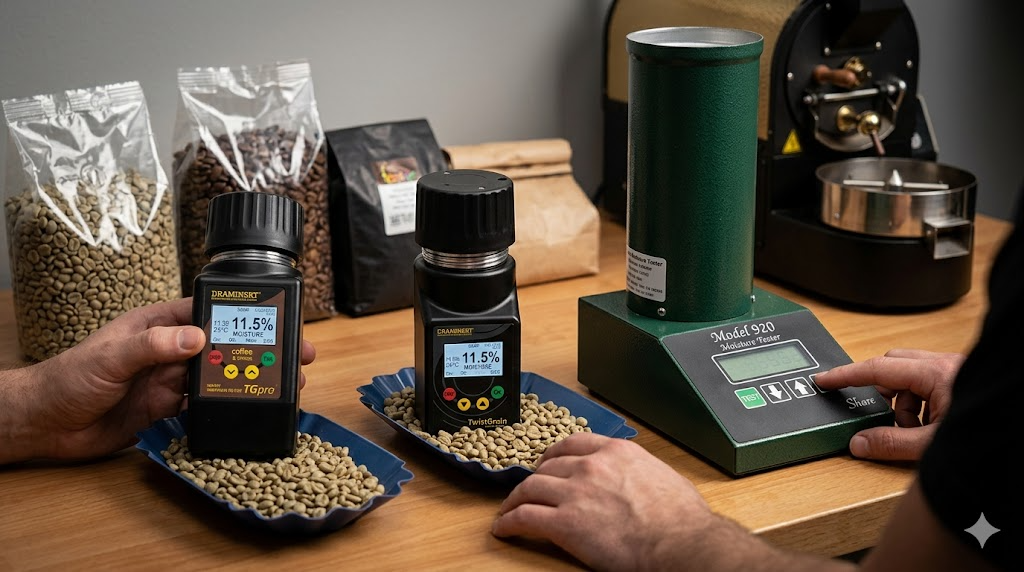
Accurate moisture measurement is a critical quality control factor in green coffee processing, roasting, and storage. Even small deviations in moisture levels can significantly affect roast development, extraction consistency, and shelf life stability. For commercial roasteries, exporters, and quality control laboratories, moisture meter accuracy is essential instrument that support data-driven decision-making and reduce production variability.
At Coffee Pro Direct, moisture meters are designed for precision, durability, and ease of calibration, allowing coffee professionals to make confident decisions based on accurate data.
Industry research shows that optimal green coffee moisture levels typically range between 10% and 12%, with deviations beyond ±1% significantly increasing the risk of roasting inconsistency and storage defects.
| Coffee Stage | Typical Moisture Range (%) | Quality Risk Level |
|---|---|---|
| Freshly Harvested Beans | 50–60% | Very High (requires drying control) |
| Processed Green Beans | 10–12% | Low (industry standard range) |
| Over-Dried Beans | <9% | Medium–High (flavor loss risk) |
| Improperly Stored Beans | >13% | High (mold & fermentation risk) |
Understanding Coffee Moisture and Its Impact
Coffee beans are hygroscopic, meaning they absorb and release moisture depending on environmental conditions. Moisture content affects not only the roasting curve but also the flavour profile of the finished coffee. Green coffee beans with too high moisture can steam during roasting, resulting in uneven colour and underdeveloped flavours. Conversely, overly dry beans can roast too quickly, producing burnt or bitter notes. Measuring and managing moisture accurately is therefore essential to achieving consistent results across every batch.
How Moisture Meters Work
Modern moisture meters use electrical resistance, capacitance, or infrared technology to determine water content in coffee beans. Electrical resistance meters measure how easily electricity passes through the beans, which varies with water content. Capacitance meters detect the dielectric constant of beans, while infrared meters evaluate moisture based on heat absorption patterns. Regardless of the method, proper calibration ensures that readings match actual bean moisture levels, providing reliable guidance for roasting and storage decisions.
Most commercial coffee moisture meters operate within an accuracy range of ±0.1% to ±0.5%, depending on sensor technology and calibration quality. Capacitive and resistance-based systems remain the most widely used in coffee quality control environments.
| Calibration Method | Accuracy Level | Stability | Use Case |
|---|---|---|---|
| Factory Calibration | ±0.5% | Medium | Entry-level devices |
| Standard Sample Calibration | ±0.2% | High | Roasteries & QC labs |
| Multi-point Calibration | ±0.1% | Very High | Specialty coffee labs |
| Field Recalibration (On-site) | ±0.3–0.5% | Medium | Export & farm use |
Standard Calibration Methods
Calibration begins with standard samples that have a known moisture content. Using these reference beans allows coffee professionals to adjust the meter until readings align with true values. This process removes discrepancies caused by sensor drift, bean density, or environmental factors. Proper calibration ensures that every subsequent measurement accurately reflects the bean’s moisture content, supporting consistency and quality control.
In professional coffee labs, recalibration is typically performed every 2–4 weeks or after significant environmental exposure, ensuring drift remains within acceptable tolerance limits.
| Year | Global Coffee Moisture Testing Equipment Market (USD Billion) | CAGR |
|---|---|---|
| 2022 | 0.42 | — |
| 2024 | 0.55 | 6.5% |
| 2026 (Projected) | 0.72 | 6.5% |
| 2030 (Projected) | 0.98 | 6.5% |
Adjusting for Bean Types and Density
Coffee beans vary by origin, size, and density. These variations can affect the accuracy of moisture readings. Calibration should therefore be tested across different bean types to account for natural differences. Speciality coffee often includes beans from multiple regions, each with unique density and moisture characteristics. A well-calibrated moisture meter from Coffee Pro Direct allows reliable readings for a wide range of coffee varieties, ensuring consistent roast profiles regardless of origin.
Density variations between Arabica and Robusta beans can create moisture reading deviations of up to 0.3–0.6%, making calibration adjustment essential when switching between origins or processing methods.
The Role of Moisture Accuracy in Roasting
Roasting is a delicate process where temperature, airflow, and time interact to develop flavour. Moisture content influences heat absorption and bean expansion. Accurate moisture readings allow roasters to adjust profiles, ensuring even development and consistent flavour. Without moisture meter accuracy, batches may roast inconsistently, producing variable results that undermine product quality and brand reputation.
Integrating Moisture Meters into Quality Control
Moisture meters play a vital role in coffee quality control. They help evaluate new green coffee lots, verify compliance with storage standards, and guide blending decisions. Moisture meter accuracy support data-driven decisions, reducing the risk of defects and wasted batches. By integrating moisture meters with other lab tools such as grading sieves, sample dividers, and lab roasters, coffee businesses can establish a comprehensive quality control workflow that maintains excellence from raw bean to cup.
Routine Maintenance for Accuracy
Maintaining moisture meters is essential to preserve accuracy over time. Sensors should be cleaned regularly to remove residues that may affect readings. Devices should be stored in controlled environments to prevent exposure to extreme humidity or temperature fluctuations. Coffee Pro Direct moisture meters are designed for durability and ease of maintenance, ensuring long-term reliability and precise measurements.
Environmental Considerations in Calibration
Calibration must consider environmental factors such as temperature and ambient humidity. Sensors may react differently under varying conditions, potentially skewing readings. Establishing calibration protocols that account for the workspace environment ensures that moisture meters deliver consistent and reliable data. Properly managed environmental calibration enhances reproducibility and ensures confidence in quality assessments.
Troubleshooting Common Moisture Meter Issues
Even high-quality moisture meters may occasionally provide inconsistent readings. Common causes include sensor contamination, improper calibration, or fluctuations in bean temperature. Systematic testing with standard samples, cleaning, and recalibration resolves most issues. Coffee Pro Direct offers devices engineered for minimal drift and consistent performance, reducing the frequency of troubleshooting and maintaining smooth lab operations.
Implications for Coffee Storage
Moisture readings guide storage decisions to prevent mould growth, staling, or over-drying. Coffee stored at optimal moisture levels maintains its flavour and aroma for longer periods. Moisture meter accuracy enables proper storage adjustments, including controlled humidity environments and packaging decisions, ensuring that beans retain their quality until roasting.
Using Moisture Data to Optimise Production
Moisture readings inform roasting decisions, helping adjust roast curves, airflow, and drum speed based on bean condition. Accurate data reduces batch inconsistencies and supports reproducible flavour profiles. Speciality coffee operations benefit from this level of precision, producing a reliable product that meets customer expectations every time.
Advanced Features of Coffee Pro Direct Moisture Meters
Coffee Pro Direct moisture meters feature digital calibration, rapid measurement, and integration with lab management systems. These advanced tools allow coffee professionals to monitor moisture in real-time, log historical data, and make informed decisions. Such precision supports research, product development, and high-volume production without sacrificing quality.
Training and Best Practices
Proper use of moisture meters requires training and adherence to best practices. Coffee professionals should understand calibration procedures, test multiple samples, and integrate moisture readings with other quality assessments. Coffee Pro Direct supports operators with guidelines and technical resources to maximise the accuracy and utility of their equipment.
Why Choose Coffee Pro Direct
Coffee Pro Direct provides high-precision, durable moisture meters designed for speciality coffee professionals. Our equipment ensures accurate readings, ease of calibration, and integration with broader quality control workflows. By choosing Coffee Pro Direct, coffee businesses benefit from reliable tools that support consistent flavour development, operational efficiency, and excellence in every batch.
Conclusion
Accurate moisture measurement is fundamental for coffee quality, consistency, and storage management. Calibrated moisture meters allow precise evaluation of green and roasted beans, guiding roasting profiles, storage practices, and quality control processes. Regular calibration, proper maintenance, and integration with other lab equipment ensure reliability and reproducibility. Coffee Pro Direct offers moisture meters designed for precision, ease of use, and long-term performance, enabling coffee professionals to maintain superior quality and achieve consistent results across every batch.