
Ever wonder why your roast sometimes tastes flat, even when you follow every step to the letter? It might not be your technique; it could be your beans. That’s where a coffee moisture meter for lab testing by Coffee Pro Direct comes in. Think of it like a secret weapon: hidden in plain sight, but essential for unlocking a consistent, flavorful roast. I remember my first batch that truly sang; it all started with dialing in the moisture. If you’re serious about roasting, understanding your green beans is everything.
Let’s talk about the tools that help you roast like a pro.
What Is a Coffee Moisture Meter, And Why Should You Care?
Understanding the Moisture Behind the Roast
Moisture content in green coffee beans is like the hidden heartbeat of your roast. Too dry, and you risk scorching or dull flavor. Too wet, and you’ll struggle with inconsistent development and mold risks. Most beans arrive between 10% and 12% moisture, but “within range” doesn’t mean “ideal.” Roast Magazine highlights that moisture variability even within acceptable ranges can produce measurably different roast development times and flavor outcomes, making precise measurement a professional necessity rather than a luxury.
Moisture content is one of the most critical variables affecting coffee roasting performance. Green coffee beans contain natural water that influences how heat transfers through the bean during roasting. If moisture levels are too high or too low, roasting behaviour becomes unpredictable and flavour development may suffer. For this reason, professional roasteries and coffee labs measure moisture levels before roasting using calibrated moisture meters.
Global Coffee Moisture Standards
| Moisture Metric | Standard Value |
|---|---|
| Ideal moisture range for green coffee | 10–12% |
| Maximum acceptable moisture for export | ~12.5% |
| Over-moisture risk threshold | Above 13% |
| Low-moisture risk threshold | Below 9–10% |
| Moisture in fresh coffee cherries | ~60% before drying |
Green coffee is typically dried from about 60% moisture in fresh cherries to roughly 10–12% for safe storage and roasting.
Guesswork Isn’t Enough
A coffee moisture meter for lab testing doesn’t guess; it gives you precise, data-backed insight. You’re not relying on feel or guesswork. You’re measuring what actually matters before the first crack even thinks about popping.
For professionals, that level of control is non-negotiable. You’re not just chasing a good cup, you’re crafting a reliable, repeatable experience. Our Lab Module is designed to house exactly this kind of precision equipment, giving your moisture meter a proper home in a professional evaluation setup.
In traditional roasting environments, moisture levels were often estimated visually or based on supplier data. However, modern specialty coffee operations rely on precise measurements to eliminate uncertainty. A lab-grade moisture meter allows roasters to verify moisture content immediately when beans arrive, helping them adjust roasting profiles and storage conditions accordingly.
Inside the Lab: What Makes Coffee Pro Direct’s Moisture Meter Stand Out
Built for Accuracy, Designed for Real Workflows
At Coffee Pro Direct, we don’t build tools for show, we build them for working pros who live and breathe roast quality. Explore our complete lab equipment range to see how each tool, from grinders to sieves to moisture meters, fits into a professional coffee lab workflow. Our coffee moisture meter for lab testing is engineered to deliver accuracy you can depend on, day after day.
Key Features That Matter
Coffee Pro Direct’s lab-grade moisture meter offers precision that matters. Its sensors measure moisture content to within a fraction of a percent, delivering fast, real-time results with minimal sample preparation. Designed for busy labs and roasteries, it’s durable, easy to calibrate, and built to maintain accuracy even under heavy daily use. Unlike handheld hobbyist models, this meter gives roast masters, Q graders, lab technicians, and sourcing professionals the confidence they need in every measurement.
The Business of Better Beans: How Accurate Moisture Readings Drive ROI
Consistency Is the Real Currency
Now, let’s talk numbers. Because while quality is the soul of coffee, consistency is the backbone of your business.
With a coffee moisture meter for lab testing, you’re not just getting better roasts, you’re saving time, reducing waste, and protecting your margins. Imagine catching a high-moisture lot before it throws off your entire production run. When moisture data is dialed in, your Sample PRO 100 Roaster trial results become far more reliable, since every test roast begins from a verified, consistent baseline. Or dialing in water activity data to improve shelf life and storage protocols.
In professional coffee labs, several analytical tools are used together to evaluate green coffee quality before roasting. Moisture meters play a central role because moisture levels influence roast development time, heat transfer, and flavour stability.
Coffee Lab Quality Control Tool Usage
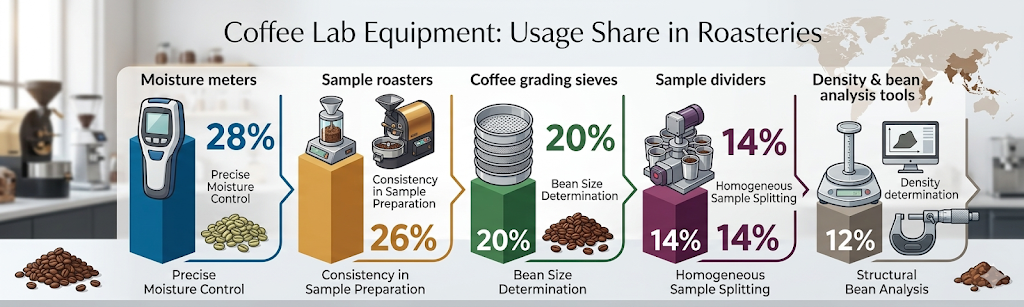
Moisture meters are widely used because even a 1% variation in moisture can significantly affect roast behaviour and development curves.
Efficiency Without Compromise
That’s real value, batch after batch. Purchasing the right equipment doesn’t just elevate your roast; it protects your reputation. Whether you run a boutique roastery or a high-output operation, investing in better input data means fewer variables and more predictable, profitable output.
Accurate moisture measurement also improves supply chain management. Roasteries can verify moisture levels at delivery, monitor storage stability, and track how green coffee beans change over time. This data-driven approach helps reduce roasting errors, protect green coffee inventory, and maintain consistent cup quality.
Choosing the Right Tool: Moisture Meters Compared
Not All Meters Are Built Alike
There’s no shortage of moisture meters out there. Some are compact and cheap. Others look impressive but offer questionable accuracy. So how do you decide? For roasteries building a full QC workflow, a moisture meter works best alongside a sample divider ensuring that the beans you’re measuring are as representative of the full lot as the reading itself is accurate.
Different moisture levels influence roasting behaviour in different ways. Measuring these variations allows roasters to adjust roasting profiles and maintain consistent flavour development across batches.
Impact of Moisture Levels on Coffee Roasting
| Moisture Level | Roasting Behaviour | Quality Impact |
|---|---|---|
| Below 9% | Beans roast too quickly | Loss of aroma and flavour |
| 10–11% | Ideal roasting performance | Balanced flavour development |
| 11–12% | Acceptable range | Slightly longer drying phase |
| 12–13% | Slower roast | Risk of uneven development |
| Above 13% | Difficult roasting | Mold risk and poor shelf stability |
Maintaining the 10–12% moisture range ensures predictable roasting behaviour and stable coffee storage conditions.
What Sets Coffee Pro Direct Apart
When choosing a moisture meter for coffee, it helps to understand the tiers: basic meters work for home use or hobbyists but often fall short in reliability for professional workflows. Mid-range models offer better sensors but can still produce inconsistent results without proper lab calibration. Lab-grade meters, like those from Coffee Pro Direct, are built for precision, durability, and daily use.
Our coffee moisture meter delivers scientific-grade accuracy with minimal setup. It’s fast, intuitive, and capable of handling dozens of samples each day, giving you actionable data you can trust. Whether for a professional lab, cupping room, or roastery floor, it’s an investment that quickly pays for itself in consistency, quality control, and confidence. Round out your QC toolkit with sample sieves for physical grading, and refer to the Coffee Quality Institute for globally recognized benchmarks on green coffee quality evaluation.
Final Brew Thoughts
Great coffee doesn’t happen by accident. It’s a dance of timing, intuition, and precision, and it starts with knowing exactly what’s in your beans. From the moisture meter to the cupping table, every stage of quality control deserves the right tool. If you’ve never used a coffee moisture meter for lab testing, you might be flying blind without even realizing it. This isn’t about gadgets, it’s about giving yourself every advantage. Coffee Pro Direct’s solution offers the kind of dependable, lab-quality performance serious professionals demand, without the friction of overcomplicated tech.
If you’re curious, explore our range or order yours today, because once you taste the difference data can make, there’s no going back.
Browse our Sample Pro 100 Roaster today
Let us help you build the perfect lab for your needs