
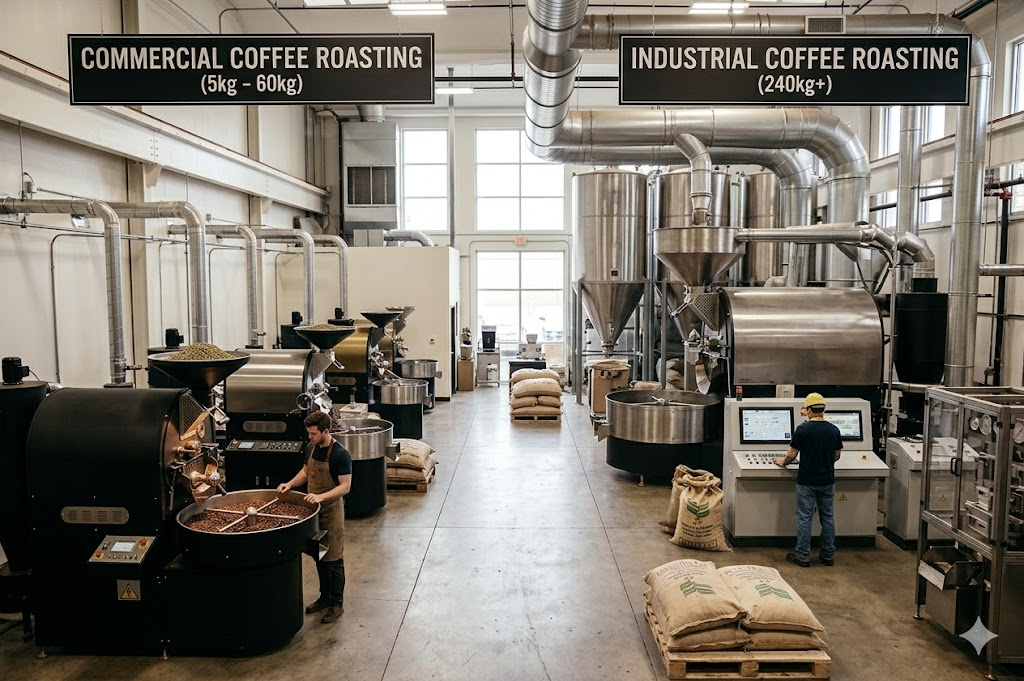
Coffee roasting equipment plays a decisive role in determining production capacity, operational efficiency, and product consistency across different business scales. For growing coffee companies, choosing between commercial and industrial roasting machines is not just a technical decision it directly impacts throughput, cost per kilogram, and long-term scalability. When building or expanding a roasting business, choosing between a commercial coffee roaster and an industrial roasting machine is one of the most significant decisions. At Coffee Pro Direct, we work closely with professionals who are scaling their operations and need clarity on which type of roaster fits their production goals. Understanding the differences between commercial and industrial coffee roasters is key to optimising performance, cost efficiency, and flavour consistency.
In this comprehensive guide, we will explore how these two categories differ in size, design, capacity, energy efficiency, automation, and application. Whether you’re running a speciality café or managing a large-scale roasting facility, this guide will help you identify the roaster that best aligns with your business vision.
Understanding Coffee Roaster Classifications
Coffee roasters are typically categorised by their capacity and function. Commercial roasters are designed for small to medium-scale operations, while industrial roasters cater to high-volume production environments. The choice depends on how much coffee you plan to roast per batch and how frequently you need to operate.
In practical terms, commercial roasters typically operate within the 1kg–30kg batch range, while industrial systems exceed 60kg per batch and are designed for continuous or semi-continuous production workflows.
At Coffee Pro Direct, we provide both commercial and industrial solutions to match our clients’ goals. Each type offers distinct advantages in precision, throughput, and automation, so understanding their technical specifications can save you time, energy, and resources in the long term.
| Roaster Category | Global Usage Share (%) | Typical Users |
|---|---|---|
| Commercial Roasters (1–30kg) | 64% | Cafés, micro-roasteries, specialty brands |
| Industrial Roasters (60kg+) | 26% | Large-scale producers, exporters |
| Hybrid / Semi-Industrial Systems | 10% | Scaling businesses |
What is a Commercial Coffee Roaster?
A commercial coffee roaster is a medium-capacity roasting machine typically designed for cafés, coffee shops, micro-roasters, and small roasteries. These machines can roast anywhere from 500 grams up to 30 kilograms of coffee per batch, making them perfect for businesses that value flexibility, craft control, and unique flavour profiling.
These systems are optimised for flexibility and flavour control, allowing operators to adjust roast variables in real time, which is critical for specialty coffee production and small-batch consistency.
We design our commercial roasters to offer consistent heat transfer, advanced airflow control, and user-friendly digital interfaces. The goal is to allow roasters to fine-tune every variable, temperature, airflow, drum speed, and time, to achieve precise roasting results that showcase each bean’s origin characteristics.
What is an Industrial Coffee Roaster?
Industrial coffee roasters, on the other hand, are engineered for large-scale production. These machines are built to handle continuous, high-volume roasting with batch sizes ranging from 60 kilograms up to several hundred kilograms. Their advanced automation systems and energy-efficient designs ensure consistent output with minimal manual intervention.
Industrial roasting systems are engineered for throughput and repeatability, often integrating automated feeding, roasting, and cooling processes to handle hundreds of kilograms per hour with minimal manual input.
Industrial models often include integrated cooling trays, destoners, and exhaust management systems for better workflow efficiency. We offer industrial roasters that combine power with precision, allowing businesses to scale production without compromising quality or flavour uniformity.
Production Capacity and Throughput
The most noticeable difference between commercial and industrial roasters is capacity. A commercial roaster might handle a few batches per hour, while an industrial machine can process hundreds of kilograms continuously. This makes industrial systems ideal for coffee producers, wholesalers, and large roasteries catering to export or national distribution markets.
At Coffee Pro Direct, we advise clients to match capacity with projected demand. Oversizing too early can lead to unnecessary costs, while undersizing can create bottlenecks in production. Selecting the right model ensures efficient output and optimal energy consumption.
| Feature | Commercial Roaster | Industrial Roaster |
|---|---|---|
| Batch Size | 1–30 kg | 60–500+ kg |
| Output per Hour | 10–200 kg | 500+ kg |
| Automation Level | Manual to Semi-auto | Fully automated (PLC systems) |
| Flexibility | Very High | Medium |
| Cost Range | Lower CapEx | High CapEx, lower cost/kg |
| Best Use Case | Specialty & retail roasting | Mass production & export |
Roasting Control and Automation
Commercial coffee roasters emphasise manual control, allowing artisans to make fine adjustments throughout the roast. Many roasters prefer this level of engagement because it provides hands-on control over flavour development.
Automation in industrial systems can improve batch repeatability by over 90%, reducing human error and ensuring consistent flavour profiles across large production volumes.
Industrial roasters, however, are equipped with programmable logic controllers (PLCs) and automated roasting profiles. These systems record and replicate roast curves automatically, ensuring consistency across hundreds of batches. We supply machines that offer both manual and automated operation modes, giving users flexibility depending on production demands.
Design and Build Quality
Both roaster types are built with high-grade materials to ensure durability and performance. Commercial roasters prioritise compactness and aesthetic appeal, suitable for in-shop roasting setups. Industrial roasters, however, are designed for heavy-duty use, featuring reinforced drums, robust insulation, and high-powered motors.
At Coffee Pro Direct, we use stainless steel drums and heat-resistant coatings to ensure long service life and stable thermal transfer, regardless of roasting volume.
Energy Efficiency and Sustainability
Sustainability is an increasingly important factor for roasteries. Commercial roasters typically use gas or electric heating systems optimised for small batches. Industrial roasters incorporate heat recovery and air recirculation systems to minimise fuel consumption.
Industrial roasting systems increasingly incorporate heat recovery and air recirculation technologies, which can reduce fuel consumption per kilogram by up to 20–30% compared to smaller standalone systems.
We integrate eco-friendly designs across our product line, offering energy-efficient burners, precision thermocouples, and insulation systems that reduce emissions while maintaining roast consistency.
Space and Infrastructure Requirements
A commercial coffee roaster requires minimal setup and can be installed in small spaces like cafés or micro-roasteries. Industrial roasters, by contrast, demand dedicated infrastructure, including ventilation systems, gas lines, and reinforced flooring.
Before installation, we conduct layout assessments to ensure proper airflow, exhaust routing, and ergonomic workspace design. Planning for space and infrastructure is essential to ensure compliance with safety and performance standards.
Maintenance and Longevity
Maintenance needs differ between the two roaster types. Commercial machines require regular cleaning and occasional part replacements due to smaller-scale use. Industrial systems need routine calibration and mechanical inspections, as they operate longer hours and handle larger loads.
Our support team provides detailed maintenance guides and offers service packages that include calibration, part replacement, and safety inspection. Consistent maintenance ensures that your roaster continues to perform reliably for years.
Cost Considerations
Commercial roasters generally cost less due to their smaller capacity and simpler controls. They are ideal for startups and speciality coffee businesses aiming for small-batch roasting. Industrial roasters, being more complex, come with higher initial investment but lower operational costs per kilogram roasted.
While industrial systems require significantly higher upfront investment, they offer lower operational costs per kilogram due to economies of scale and higher throughput efficiency.
At Coffee Pro Direct, we help clients calculate long-term ROI by balancing purchase cost, fuel consumption, and production efficiency. The right investment decision depends on your current and projected production scale.
Application in Business Models
Commercial roasters suit small coffee brands, local cafés, and training labs that emphasise craftsmanship and flexibility. Industrial machines, on the other hand, are best suited for companies producing large volumes for wholesale or export.
We provide tailored solutions for both segments, customising control systems, batch sizes, and automation features to match your exact needs. Whether you are just entering the coffee market or expanding to industrial-scale production, our team ensures a seamless transition.
| Year | Global Coffee Roasting Equipment Market (USD Billion) | Industrial Share |
|---|---|---|
| 2022 | 1.7 | 42% |
| 2024 | 2.2 | 44% |
| 2026 (Projected) | 2.8 | 46% |
| 2030 (Projected) | 3.9 | 48% |
Flavour Consistency and Quality Output
Smaller, commercial coffee roaster allow for greater experimentation, making them ideal for developing signature profiles. Industrial roasters maintain exceptional uniformity across large batches, ensuring brand consistency for mass production. Commercial roasters provide greater flexibility for experimentation, while industrial systems prioritise uniformity, ensuring consistent product quality across large distribution networks.
Our roasters are engineered with precise airflow and temperature management systems, delivering consistent roast profiles and maximum flavour retention at any scale.
Why Choose Coffee Pro Direct
We at Coffee Pro Direct are committed to providing world-class roasting equipment that supports every stage of your coffee journey. From small-batch commercial models to high-capacity industrial roasters, our machines are built for performance, reliability, and flavour precision.
Our expert team works directly with clients to recommend the most suitable roaster configuration for their business size, goals, and operational workflow. With years of experience in coffee technology, we ensure that every machine we deliver meets international safety and efficiency standards.
Whether you’re roasting a few kilograms per week or managing large-scale production, Coffee Pro Direct provides the equipment, training, and after-sales support you need to achieve consistent, world-class results.
Our Business Location
You can find Coffee Pro Direct at our headquarters: 21st Floor, CMA Building, 64 Connaught Road Central, Hong Kong. From this central hub, we serve professionals across Asia, Europe, and the Americas, providing cutting-edge roasting technology and expert consultation.
Conclusion
Ultimately, the choice between commercial and industrial coffee roasters depends on production scale, operational strategy, and long-term growth objectives. Businesses focused on specialty quality and flexibility benefit from commercial systems, while those targeting high-volume distribution gain efficiency and consistency from industrial solutions.
At Coffee Pro Direct, we bridge the gap between artistry and industry by offering coffee roasters that deliver precision, durability, and consistent quality at every level. With our expertise and state-of-the-art technology, we help you make the right investment to grow your coffee business with confidence.
Browse our Sample Pro 100 Roaster today
Let us help you build the perfect lab for your needs