
In the specialty coffee industry, quality is not a matter of opinion; it is a measurable outcome. Every decision you make, from sourcing green beans to dialling in a roast profile, depends on accurate data produced by reliable testing equipment. Without it, consistency becomes guesswork, defects go undetected, and the gap between your coffee and your competitor’s narrows fast.
The global specialty coffee market was estimated at USD 111.5 billion in 2025 and is projected to reach USD 251.70 billion by 2033, growing at a CAGR of 10.8%. As the market expands and consumer expectations for quality and transparency rise, the coffee professionals who invest in structured, equipment-driven quality control are the ones who build lasting reputations.
Coffee PRO Direct is a specialist coffee testing equipment supplier serving roasters, processors, importers, labs, and cooperatives across 60+ countries. With over 16 years of manufacturing experience and 700+ customers worldwide, we supply the complete range of tools your quality control lab needs from green bean intake to post-roast sensory evaluation.
What Is Coffee Testing Equipment and Why Does It Matter?
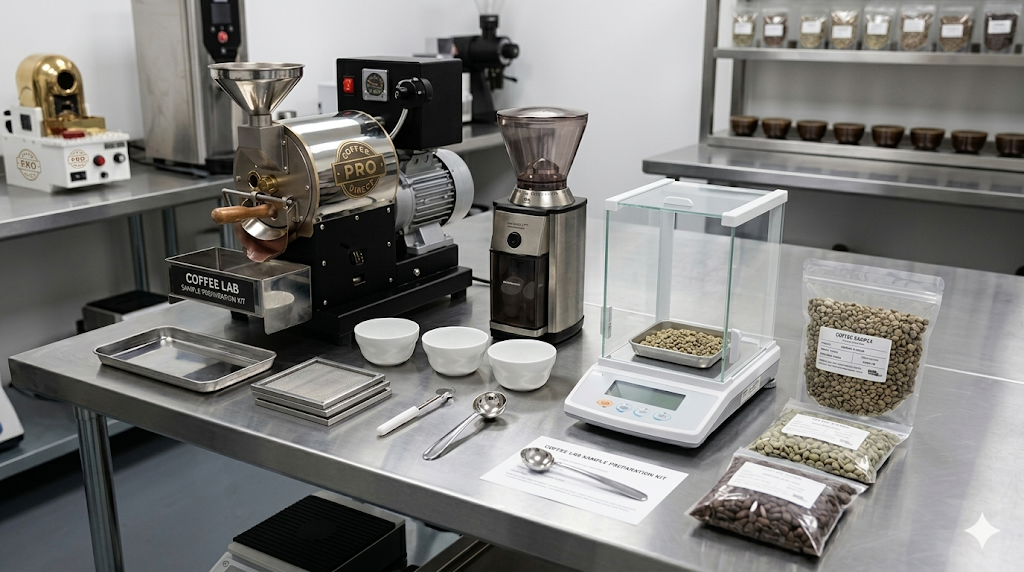
Coffee testing equipment refers to the specialized tools used to evaluate coffee at every stage of its journey from freshly harvested cherry through post-harvest processing, green bean storage, pre-roast inspection, roasting, and final sensory evaluation. Essential equipment includes coffee sample roasters, grinders, cupping trays, moisture meters, hulling machines, and analytical scales. Each tool serves a specific purpose, from sample preparation to flavour evaluation, and contributes to precise quality control.
Without a dedicated lab, coffee quality relies heavily on subjective evaluation, which may lead to inconsistencies and reduced customer satisfaction. A coffee lab empowers professionals with objective data and precision, making quality control systematic and reliable.
The cost of not testing is real. Accepting a shipment of green coffee with moisture above 12.5% risks mold contamination and a significant reduction in roast yield. Roasting without a calibrated sample roaster means you cannot predict how a new origin will behave at scale. Cupping without consistent grind size and standardized ratios produces unreliable sensory scores that cannot be compared across sessions or between buyers and sellers. Testing equipment removes this uncertainty.
The Growing Demand for Professional Coffee Quality Control
Cupping remains the industry standard for sensory evaluation, although testing protocols vary between exporters, importers, and roasters. Teams should always maintain internal consistency across every evaluation session. As the specialty coffee segment grows, supply chains continue becoming more complex. This growth increases the need for standardized, equipment-supported quality control across every stage of the supply chain.
In 2024, the Specialty Coffee Association officially adopted the new Coffee Value Assessment standards, SCA Standard 104-2024, replacing the 2004 cupping protocol and evaluation form. Researchers developed these standards using modern sensory science, industry research, and collaborative testing. The updated framework allows coffee professionals to evaluate coffee value using higher-resolution sensory and quality data.
Professional operations now require equipment that supports standardized, repeatable, and documentable testing. Quality-control equipment is no longer optional in competitive specialty coffee markets.
Complete Coffee Testing Equipment: What Every Lab Needs
A professional coffee quality control lab is built around a core set of interconnected tools. Here is what each one does, why it matters, and where it fits in your workflow.
1. Sample Roaster
A sample roaster is the starting point for evaluating any new green coffee lot. Roasting a small sample, typically 80–120g, allows you to assess how a bean develops under heat before committing to a full commercial batch. It reveals roast behaviour, development time, and the cup profile of a specific origin or processing method.
Coffee PRO Direct’s Sample PRO 100 is a professional-grade sample roaster designed for Q-Graders, cupping labs, exporters, and importers. It offers a capacity of 80–120g per drum, with 1, 2, 4, or 6 drum configurations and options for gas or electric heating, making it equally suited to single-sample evaluation and high-throughput green coffee buying programs.
2. Lab Grinder
The SCA cupping protocol requires grinding coffee immediately before evaluation within the session to preserve aroma and ensure uniform extraction during assessment. A dedicated lab grinder delivers the consistent, uniform grind size that cupping protocols demand. Variable grind settings and low heat generation during grinding are essential to avoid altering the volatile aromatic compounds you are trying to evaluate.
Coffee PRO Direct’s Lab Grinder is built specifically for cupping protocols and sensory analysis, delivering consistent grind size and particle distribution that makes every cupping session repeatable and comparable.
3. Moisture Analyzer
Moisture content is one of the most critical physical parameters in green coffee evaluation. The standard allowable moisture content, according to the SCA, is 10–12%. Any reading above 12% is generally not acceptable and could significantly reduce cupping scores within 3 months, making the coffee more susceptible to mold and other quality issues.
Coffee PRO Direct’s Moisture Analyzer — Moisture Mac II is pre-calibrated for green coffee, parchment coffee (Pergamino), and cocoa. It delivers results in 10 seconds with no sample preparation and uses a fixed-volume sample cup design that virtually never falls out of calibration making it a reliable daily-use instrument in both field and lab environments.
4. Sample Sieves
Green bean size is a key grading parameter. SCA Specialty Grade (1) requires a maximum of 5% above or below the indicated screen size, and this physical uniformity assessment forms part of the overall green coffee classification standard. Sample sieves allow you to grade beans by screen size quickly and consistently, identifying lots with poor uniformity that may roast unevenly and score lower in the cup.
Coffee PRO Direct’s Sample Sieves are precision-made for repeatable physical grading across green coffee lots, supporting your compliance with SCA and ICO green coffee classification requirements.
5. Sample Divider
A representative sample is the foundation of any meaningful test result. If your sample is not representative of the full lot, your moisture reading, sieve analysis, and cupping score are all compromised. A sample divider splits a bulk lot into statistically representative sub-samples using a consistent, repeatable mechanical process, eliminating the operator bias that comes from hand-splitting.
Coffee PRO Direct’s Sample Divider ensures that every physical analysis and cupping session starts with a truly representative portion of the lot being evaluated.
6. Parchment Coffee Huller
For processing facilities and quality control labs that receive wet-processed coffee in parchment form, hulling the sample before moisture testing or cupping is essential. Manual or improper hulling introduces physical damage that affects the accuracy of both moisture readings and sensory evaluation.
Coffee PRO Direct’s Parchment Coffee Huller removes parchment cleanly from dried beans to expose the green coffee for grading and moisture testing, without the bean damage that comes from manual methods or ill-suited equipment.
7. Cupping Table and Bowls
The SCA cupping protocol requires using 5 cups per sample for reliability, with a ratio of 8.25g of coffee per 150ml of water at 93°C, steeped for 4 minutes. A dedicated cupping table organizes this process, accommodating multiple samples simultaneously, keeping bowls stable, and providing the structured workspace that allows a cupper or Q-Grader to work efficiently through large flights of coffee.
Coffee PRO Direct’s Cupping Table and Cupping Bowls are designed to meet professional standards, supporting high-volume evaluation sessions in specialty labs, trading houses, and roasteries.
8. Spittoon
Often overlooked, a professional Spittoon is an essential part of any serious cupping station. Cuppers evaluating large numbers of samples in a single session, as is standard in green coffee buying programs and Q-Grader calibration sessions, require a dedicated, hygienic, and stable spittoon. It keeps sessions moving efficiently without compromising palate accuracy.
9. Lab Module
For labs that want an integrated, organized workspace combining multiple testing functions in a single unit, Coffee PRO Direct’s Lab Module provides a compact, all-in-one evaluation environment. It is ideal for roasteries and processing facilities that need professional-grade quality control capabilities without dedicating a large separate room to the function.
10. Sampling Spear
Accurate sampling starts before any instrument is used. A Sampling Spear allows you to draw representative samples from across a bag or lot, accessing beans from multiple depths and locations, ensuring that the sample submitted for testing actually reflects the full lot’s quality, not just the surface layer.
Coffee Testing Equipment: Full Workflow Overview
| Stage | Key Testing Equipment | What It Measures / Ensures |
| Lot sampling | Sampling Spear, Sample Divider | Representative sub-samples from the full lot |
| Physical grading | Sample Sieves | Bean size uniformity, screen compliance |
| Moisture check | Moisture Analyzer (Moisture Mac II) | Moisture content vs. SCA/ICO standard (10–12%) |
| Parchment removal | Parchment Coffee Huller | Clean hulling before green analysis |
| Sample roasting | Sample PRO 100 | Roast behaviour, development, cup profiling |
| Grinding | Lab Grinder | Consistent, uniform grind for cupping |
| Sensory evaluation | Cupping Table, Cupping Bowls, Spittoon | SCA protocol cupping — aroma, flavour, body, acidity |
| Lab management | Lab Module | Integrated workspace for all QC functions |
Sources: SCA Coffee Standards; ICO Resolution 420; Coffee PRO Direct product specifications
Who Needs a Coffee Testing Equipment Supplier?
Coffee testing equipment is not exclusively for large trading houses or certified Q-Grader labs. Every professional in the coffee supply chain benefits from structured, equipment-supported quality control.
1-Specialty Roasters — Evaluating incoming green lots before purchase, developing roast profiles on the Sample PRO 100, and running consistent cupping sessions to approve batches before release. A complete lab setup built around the Lab Equipment range gives you the data backbone your quality program needs.
2-Green Coffee Importers and Exporters — Verifying moisture compliance with ICO and ISO 6673 standards, physical grading against SCA specifications, and cupping for pre-shipment approval. The combination of Sample Divider, Sample Sieves, Moisture Mac II, and Sample PRO 100 covers the complete green coffee evaluation protocol.
3-Dry Mills and Processing Facilities — Monitoring moisture at the parchment stage, running physical grading after hulling, and quality-checking milled green coffee before export. This integrates naturally with Coffee PRO Direct’s broader Green Coffee Processing equipment lines.
4-Coffee Cooperatives and Farms — Building on-site quality control capabilities to evaluate their own production, negotiate better prices with buyers, and participate credibly in specialty grading programs. Portable, simple-to-use instruments like the Moisture Mac II require minimal operator training, making them practical for field use at origin.
5-Café Groups and Wholesale Roasters — Running structured internal cupping programs to maintain consistency across blends, approve new suppliers, and ensure product quality before it reaches retail or wholesale customers.
Specialty Coffee Market: Why Quality Infrastructure Matters Now
The global specialty coffee market reached an estimated USD 111.5 billion in 2025 and analysts project it will grow to USD 251.70 billion by 2033 at a CAGR of 10.8%, driven by evolving consumer preferences and growing demand for high-quality coffee products.
The U.S. specialty coffee market reached an estimated USD 47.8 billion in 2024 and analysts project it will grow at a CAGR of 9.5% from 2025 to 2030. As the market matures, consumers increasingly demand transparency, traceability, and consistency. Coffee businesses can only deliver these standards by building quality control into every stage of operations and supporting the process with professional equipment.
For roasters and processors looking to grow in this environment, the question is not whether to invest in coffee testing equipment; it is which supplier to trust with building your quality infrastructure.
Specialty Coffee Market Growth at a Glance
| Metric | Data | Source |
| Global specialty coffee market (2025) | USD 111.5 billion | Grand View Research, 2025 |
| Projected market size (2033) | USD 251.70 billion | Grand View Research, 2025 |
| CAGR (2026–2033) | 10.8% | Grand View Research, 2025 |
| U.S. specialty coffee market (2024) | USD 47.8 billion | Grand View Research, 2024 |
| U.S. market CAGR (2025–2030) | 9.5% | Grand View Research |
| North America market share (2025) | 50.7% | Grand View Research, 2025 |
Source: Grand View Research — Specialty Coffee Market Report
Why Choose Coffee PRO Direct as Your Coffee Testing Equipment Supplier?
Coffee PRO Direct is not a general laboratory equipment distributor. We are a specialist coffee company with 16+ years of experience supplying professional-grade equipment specifically designed for the coffee industry — understanding not just the tools, but how they fit into real-world coffee workflows from cherry to cup.
1-Industry-Specific Equipment — Every piece of equipment in our lab range is selected and configured for coffee, cocoa, and related commodities not repurposed from generic laboratory catalogues.
2-Complete Lab Solutions — From a single instrument like the Moisture Mac II to a complete lab build, we supply everything in one place. Our PRO Solutions service handles turnkey lab design, equipment sourcing, and consolidated shipping for businesses building from the ground up.
3-Global Reach, Local Knowledge — With customers in 60+ countries and operations in Sofia, Bulgaria and Ho Chi Minh City, Vietnam, we understand the supply chain realities of coffee professionals operating across diverse origins, climates, and regulatory environments.
4-Roasting Expertise — As a full-spectrum coffee equipment company, we also supply the CraftMaster Series roasters from the CM1 (1kg) through to the CM120 (120kg industrial), meaning your testing equipment and your roasting equipment come from one trusted supplier with a consistent design philosophy.
5-Direct Support — Our team understands coffee. When you have a question about what a moisture reading means, how to structure a cupping program, or which configuration of the Sample PRO 100 suits your buying volume, you get answers from people who know the industry.
Contact us to discuss your lab requirements or request a quote for any piece of equipment.
Building Your Coffee Testing Lab: Investment Guide
| Lab Configuration | Recommended Equipment | Best For |
| Entry-level intake lab | Moisture Mac II, Sample Sieves, Sample Divider, Sampling Spear | Small roasters, importers starting QC |
| Full cupping lab | Above + Lab Grinder, Cupping Table, Cupping Bowls, Spittoon | Specialty roasters, green buyers, trading houses |
| Complete QC lab | All above + Sample PRO 100, Lab Module, Parchment Huller | Processing facilities, exporters, Q-Grader labs |
| Turnkey operation | Full equipment + PRO Solutions setup service | New roasteries, cooperatives, and dry mills building from scratch |
For a tailored quote based on your specific requirements, contact Coffee PRO Direct directly.
Related Reading
Why a Professional Cupping Table Is a Game-Changer for Serious Coffee Labs |Why an Adjustable Coffee Cupping Table Can Elevate Your Roastery Workflow |Coffee Lab Equipment – Build a World-Class Coffee Lab |Dialing In Precision – Why the Right Lab Grinder Transforms Coffee Sample Prep |Coffee Lab Setup for Exporters – Improve Testing & Export Quality
Browse our Sample Pro 100 Roaster Today
Let us help you build the perfect lab for your needs