
A coffee lab roasting station is an essential setup for coffee professionals who need to test, evaluate, and profile coffee beans before full production roasting. In specialty coffee labs, quality control departments, and roasting facilities, a dedicated lab roasting station provides the tools and environment necessary to assess small batches of coffee accurately and consistently. This controlled approach supports decisions involving green coffee evaluation, roast profiling, cupping comparison, and quality assurance. Coffee Pro Direct offers professional-grade coffee lab roasting stations designed to provide precision, repeatability, and reliable performance helping businesses evaluate coffee characteristics with confidence before scaling up to shop, commercial, or industrial roasters.
Modern coffee quality control relies heavily on laboratory scale roasting systems as defined by SCA quality evaluation standards. Coffee labs use small-batch roasting stations to analyze green coffee characteristics such as density, moisture behavior, and roast development. By roasting small samples before full production, coffee professionals can identify optimal roast profiles while reducing waste and ensuring consistent flavor development across commercial batches.
In a market where consistency and quality determine brand reputation and customer satisfaction, having a dedicated lab roasting station enables teams to refine roast profiles, identify defects early, and understand how different beans respond to heat. By incorporating lab roasting into quality workflows, coffee professionals can ensure that production choices are backed by scientific analysis and sensory evaluation, ultimately improving overall product quality.
What Is a Coffee Lab Roasting Station
A coffee lab roasting station is a compact setup that includes a sample roaster, supporting tools, and analytical instruments used for small batch roasting and evaluation. Unlike full‑scale roasting operations, a lab station is designed to handle controlled tests on limited sample volumes, typically anywhere from a few dozen grams to a few hundred grams. The purpose of a lab roasting station is not to produce roasted coffee for sale but to provide accurate, reproducible results that reflect green coffee behavior under controlled conditions. This approach enables lab technicians, roasters, and quality managers to evaluate coffee objectively and make data‑driven decisions.
The Importance of Lab Roasting in Quality Control
Lab roasting plays a crucial role in quality control by offering a consistent method for assessing how green coffee beans will respond during roasting. By using a lab roasting station, professionals can compare different lots under identical conditions, revealing nuances in flavor, body, acidity, and aroma that may not be evident without standardized roasting. This information helps roasters tailor production roast profiles that achieve desired results while minimizing variability in cup quality.
In addition, lab roasting allows teams to detect issues such as uneven development, bean density variations, or inconsistent moisture levels before committing valuable resources to larger roasts. This early detection saves time, reduces waste, and helps maintain high quality standards throughout the production process.
Core Components of a Coffee Lab Roasting Station
A coffee lab roasting station typically includes a sample roaster, an adjustable sample coffee roaster for flexible testing, precision digital cupping scales for accurate measurement, and support equipment that enhances lab workflows. The sample roaster serves as the centerpiece, designed for small batch capacity and precise control over roasting variables such as temperature, airflow, and time. Digital scales ensure that samples are weighed precisely, supporting consistent sample preparation in every test. Other accessories such as cooling trays, timers, thermometers, and data logging tools support detailed analysis of each roast.
Core Equipment in a Coffee Lab Roasting Station
| Equipment | Primary Function | Typical Specification |
|---|---|---|
| Sample PRO 100 Roaster | Small-batch roasting for evaluation | 80–120 g per drum, 1–6 drums |
| Coffee Trays | Sample organization, cooling & presentation | Non-absorbent, food-grade, stackable |
| Lab Grinder | Consistent grind for cupping tests | ±50–100 micron particle consistency |
| Digital Cupping Scales | Accurate dosing for evaluation | ±0.1 g precision — contact us for availability |
| Moisture Analyzer | Measures green coffee moisture | 9–13% range per SCA standards |
This equipment combination allows labs to test coffee samples, analyse roasting behaviour, and prepare beans for sensory evaluation.
Sample Roasters and Their Role
Sample roasters in a lab roasting station are specialized machines built to roast small quantities of coffee under controlled conditions. These roasters allow operators to adjust heat, airflow, and roast duration to produce repeatable results. Sample roasting informs decisions about how beans react to different parameters, providing critical insights before scaling up to shop, commercial, or industrial production roasters.
Sample roasting also supports blend development and quality comparison, enabling professionals to test multiple lots side by side and evaluate their sensory profiles. Coffee Pro Direct‘s Sample PRO 100 is designed for durability, precision, and ease of use in lab settings available in 1, 2, 4, or 6 drum configurations with gas or electric heating making it ideal for quality control applications.
Supporting Measurement and Analysis Tools
Beyond the sample roaster, a coffee lab roasting station includes tools that support accurate measurement and analysis. Operators use precision digital scales to weigh green coffee samples and control coffee-to-water ratios during cupping or extraction tests. They use thermometers and timers to monitor roasting conditions and ensure tests follow consistent parameters. These tools help quality teams document and replicate test conditions effectively.
Coffee Pro Direct provides measurement tools that integrate seamlessly into lab workflows, supporting both analytical and sensory evaluation processes.
Quality Control Protocols in Lab Roasting
Incorporating quality control protocols into a lab roasting station ensures that coffee evaluations yield meaningful and actionable results. Protocols include standardizing sample size, roast profiles, and evaluation criteria so that comparisons between lots are fair and reliable. Sensory evaluation, documentation of roast curves, and analysis of physical properties such as bean density and moisture content provide a comprehensive understanding of coffee behavior.
Quality protocols also support certification processes and internal benchmarks, helping businesses demonstrate consistency and transparency in their coffee production.
Roast Profiling and Data Recording
Roast profiling is a critical function of a coffee lab roasting station. It involves adjusting temperature, airflow, and timing to understand how beans develop under different conditions. By recording roast data, quality teams can create libraries of profiles linked to specific origins, processing methods, or flavor characteristics. These profiles serve as references for production roasting and support long‑term quality consistency.
Data recorded during lab roasting helps inform adjustments in larger roasters, creating a bridge between small batch testing and full production. Coffee Pro Direct‘s lab roasting solutions include features that support data capture and analysis compatible with Artisan profiling software as standard and Cropster as an optional upgrade enhancing the value of lab tests.
Integrating Lab Roasting with Sensory Evaluation
A coffee lab roasting station works in tandem with sensory evaluation protocols such as cupping. After roasting, samples are evaluated for aroma, flavor, body, acidity, and balance. Cupping results evaluated on the cupping table with cupping bowls and a spittoon using coffee trays to organize lots provide context to the analytical data gathered during roasting and measurement, creating a complete view of coffee quality. By integrating lab roasting with cupping, professionals can correlate roast profiles with sensory outcomes, enabling more informed decisions about coffee selection and processing.
Coffee Quality Control Workflow in a Roasting Lab
| Stage | Purpose | Equipment Used |
|---|---|---|
| Green Coffee Inspection | Detect defects and bean size variations | Sample Sieves + Parchment Huller |
| Moisture Testing | Ensure correct moisture levels per ICO standards | Moisture Analyzer |
| Sample Roasting | Evaluate roast potential | Sample PRO 100 |
| Grinding & Preparation | Prepare coffee for cupping | Lab Grinder |
| Sensory Evaluation | Assess flavor and aroma per SCA protocols | Cupping Table, Cupping Bowls & Spittoon |
This workflow ensures that roasting decisions are based on data-driven evaluation rather than guesswork.
Training and Skill Development
Effective use of a coffee lab roasting station requires skill and training. Operators must understand how roasting variables influence flavor outcomes and how to interpret data collected during tests. Training programs enhance these skills, enabling teams to conduct meaningful evaluations and apply their findings to production roasting.
Coffee Pro Direct supports professional development through PRO Solutions consulting and a lab module workstation designed to make Q-Grader and SCA-standard training environments intuitive and capable helping lab teams build expertise and consistency in their analysis workflows.
Maintenance and Calibration of Lab Equipment
Regular maintenance and calibration are essential to ensure that a coffee lab roasting station continues to deliver accurate and reliable results per SCA equipment standards. Sample roasters should be cleaned routinely to prevent residue buildup, and measurement tools such as scales and thermometers should be calibrated to maintain their precision. Proper maintenance extends equipment longevity and ensures that lab tests remain consistent over time.
Routine maintenance of lab roasting stations ensures accurate measurements and consistent roasting results. Regular cleaning of roasting drums, calibration of scales, and inspection of airflow systems help maintain reliable equipment performance and extend operational lifespan.
Creating a Workflow for a Lab Roasting Station
A well-organized lab roasting station supports a smooth workflow that integrates sample preparation, roasting, evaluation, and documentation. Operators prepare samples consistently, roast them under controlled conditions, and evaluate them using standardized sensory protocols. They document results to ensure data is recorded for future reference and comparison. Coffee Pro Direct designs its lab roasting solutions to support efficient workflows that improve the accuracy and reliability of quality assessments.
Global Distribution of Coffee Lab & Quality Control Operations
| Industry Segment | Share (%) |
|---|---|
| Specialty Coffee Roasteries — shop to industrial scale | 40% |
| Coffee Quality Control Laboratories | 25% |
| Green Coffee Exporters & Importers | 18% |
| Coffee Training & Research Institutes — Q-Grader certified | 10% |
| Coffee Equipment Testing Labs | 7% |
* Market data informed by global coffee equipment demand trends tracked by the International Coffee Organization (ICO) and SCA industry research.
Specialty coffee roasteries represent the largest users of lab roasting stations as they rely heavily on small-batch testing before scaling production.
Benefits of a Dedicated Lab Roasting Station
A dedicated coffee lab roasting station offers numerous benefits to coffee businesses. It enables early detection of quality issues, supports blend development, enhances consistency in production roasting, and provides a scientific basis for roasting decisions. By incorporating lab tests into production planning, businesses can reduce risk, minimize waste, and improve overall product quality.
Global Coffee Laboratory Equipment Market
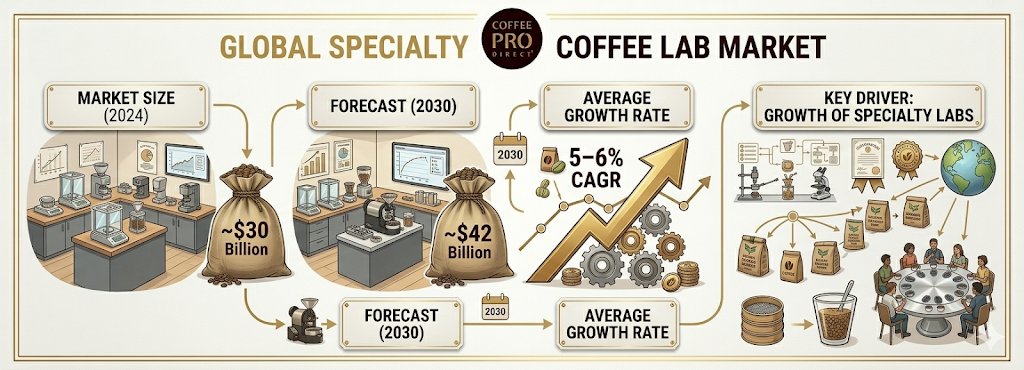
The growth of specialty coffee, origin-based sourcing, and scientific quality evaluation is driving increased investment in coffee laboratory equipment. Many modern roasteries now operate dedicated coffee labs to test beans, develop roast profiles, and maintain product consistency.
Why Choose Coffee Pro Direct?
Coffee Pro Direct is a trusted provider of professional coffee lab roasting stations and related equipment designed to support rigorous testing, quality control, and evaluation workflows. With offices in Sofia, Bulgaria and Ho Chi Minh City, Vietnam, Coffee Pro Direct serves coffee businesses worldwide with high-quality tools and expert support including the Sample PRO 100, lab grinder, cupping table, moisture analyzer, sample sieves, sample divider, coffee trays, and lab module workstation. Their lab roasting solutions are designed to deliver precision, consistency, and reliability that align with industry best practices.
By choosing Coffee Pro Direct, coffee professionals gain access to dependable sample roasters, measurement instruments, and lab setup support via PRO Solutions that help elevate quality control processes and improve decision-making. View our special deals and packages for complete lab roasting station setups at 10% off. Coffee Pro Direct’s commitment to quality and service trusted by Q-Graders and coffee professionals in 50+ countries makes it the preferred partner for labs, roasteries, and quality teams seeking professional roasting solutions.
Conclusion
A coffee lab roasting station is an indispensable part of modern coffee quality control, enabling professionals to test, evaluate, and profile coffee beans under controlled conditions. By integrating analytical tools, measurement devices, and sensory evaluation protocols, labs gain a complete understanding of coffee behavior that supports informed production decisions.
Investing in a high-quality coffee lab roasting station from Coffee Pro Direct enhances quality control workflows, strengthens consistency, and provides valuable insights that contribute to long-term success in the coffee industry. Complete your station with our sampling spear, hand sealer, parchment coffee huller, and Coffee Roasting Handbook.
For more on building a complete coffee lab roasting station, read: Coffee Lab Equipment – Build a World-Class Coffee Lab, Lab Sample Roaster – A Must-Have Tool for Professional Coffee Evaluation, Best Sample Roaster for Coffee Labs, and Lab Coffee Trays – A Must-Have Tool for Quality Control.
Browse our Sample Pro 100 Roaster today
Let us help you build the perfect lab for your needs