
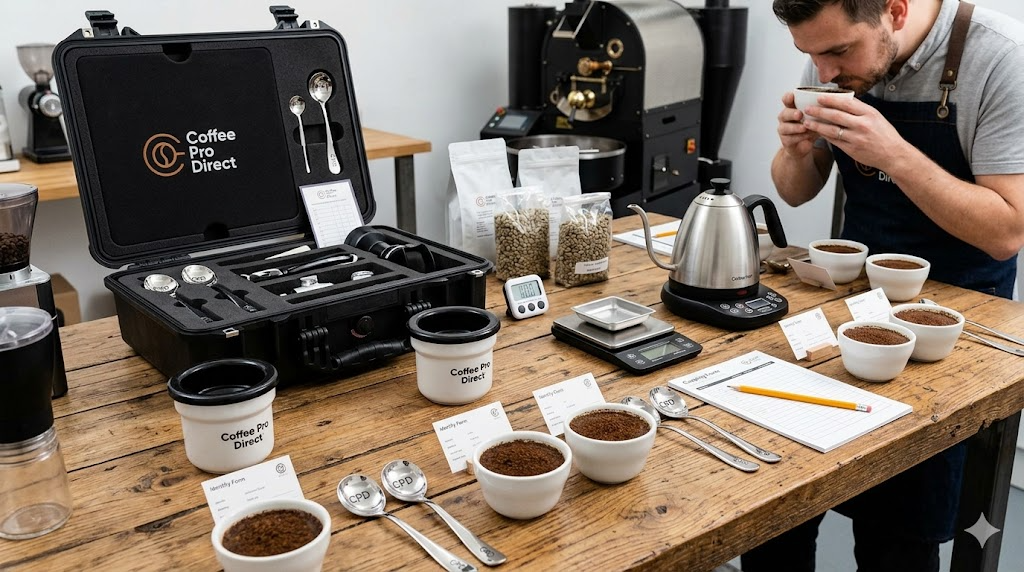
Testing accuracy is not a nice-to-have in professional coffee. It is the foundation of every reliable quality decision you make, from purchasing a green coffee lot to signing off on a production batch before it ships.
A coffee lab equipment supplier who provides the right tools, built to the right standards, and supported after every sale changes what your lab can produce. Poor equipment introduces variables that corrupt data, create inconsistencies between sessions, and undermine the confidence of the professionals and buyers who rely on your results.
This guide covers what defines a professional coffee lab equipment supplier, what every serious testing lab needs, why accuracy depends on the full tool chain, not just individual instruments and why Coffee Pro Direct is the supplier that serious coffee professionals choose.
Why Coffee Lab Equipment Accuracy Matters Now More Than Ever
The global specialty coffee market was estimated at USD 111.5 billion in 2025 and is projected to reach USD 251.70 billion by 2033, growing at a CAGR of 10.8% from 2026 to 2033.
As that market grows, so do buyer expectations. Importers require documented moisture and physical grading data. Q Graders need standardized evaluation conditions. Roasteries need repeatable trial roast results to maintain brand consistency. Cooperatives need credible sample evaluation to command specialty premiums.
The coffee processing machine market is projected to grow from USD 13,190.6 million in 2024 to USD 21,994.9 million by 2032 at a CAGR of 6.6%, driven by the growth of specialty coffee culture and demand for machines capable of producing high-quality coffee products.
The operations investing in that growth are investing in lab accuracy. Because in specialty coffee, the price premium you receive is exactly proportional to the quality you can prove.
What Makes a Coffee Lab Equipment Supplier Professional-Grade?
Before choosing a supplier, these criteria separate professional-grade partners from generic equipment vendors:
- Purpose-built for coffee. Lab instruments borrowed from other industries produce unreliable results in coffee applications. Every tool should be designed and calibrated specifically for coffee evaluation. Bean sizes, moisture ranges, batch weights, and sensory protocols are unique to coffee.
- International standards alignment. Equipment should meet the testing and evaluation standards of the Specialty Coffee Association and the Coffee Quality Institute. Without this alignment, your results are not comparable to international benchmarks limiting their credibility with buyers and certifiers.
- Complete ecosystem. Accuracy is a system property, not a single-instrument property. A moisture reading is only accurate if the sample entering the meter was representative. A cupping score is only accurate if the grind was consistent. A trial roast is only meaningful if the input was moisture-verified and size-graded. Every tool in the chain must perform for the chain to produce reliable data.
- Calibration support. Professional lab instruments require regular calibration to maintain accuracy. A supplier who provides calibration guidance, reference standards, and technical support protects your data quality over the long term.
- After-sales reliability. Downtime in a QC lab is not just inconvenient; it disrupts purchasing decisions, delays shipments, and erodes buyer confidence. Choose a supplier who stands behind every piece of equipment they sell.
The Complete Coffee Lab Equipment Range: Tool-by-Tool Guide
1. Sample Divider — Representative Sampling
What it does: Separates a bulk green coffee lot into statistically representative test portions.
Why it matters for accuracy: Every downstream measurement is only as accurate as the sample it begins with. A non-representative sample produces data that reflects one corner of a bag — not the actual lot. The Coffee Quality Institute requires standardized representative sampling as a core component of professional green coffee assessment.
Accuracy specification: ~1% variance between output pans (Coffee Pro Direct standard).
Coffee Pro Direct’s sample divider uses a gravity-fed, 32-channel cone system with dual output pans. Stainless steel construction for professional durability. No electricity required, gravity-fed operation eliminates mechanical error.
2. Sample Sieves — Physical Classification
What it does: Classifies green coffee beans by screen size using calibrated mesh sieves.
Why it matters for accuracy: Bean size affects roasting rate. Mixed-size inputs produce uneven roasts. Accurate size grading enables meaningful comparison between lots — and meets the physical classification requirements of international export grades.
Standards alignment: Calibrated to international SCA-aligned screen sizing (1/64 inch increment conventions, Screens 14–20).
Coffee Pro Direct’s sample sieves are precision-calibrated and built from stainless steel for long-term mesh integrity. They meet the grading requirements of SCA and CQI-aligned evaluation protocols.
3. Moisture Analyzer — Water Content Measurement
What it does: Measures the moisture content of green or roasted coffee beans before roasting or storage assessment.
Why it matters for accuracy: Moisture content is the most critical physical variable in green coffee evaluation. The Specialty Coffee Association defines 10–12% as the accepted range for green coffee. Readings outside this range signal storage risk, processing problems, or roasting unpredictability.
Accuracy specification: ±0.1% (Coffee Pro Direct standard) the professional benchmark for QC decision-making.
Coffee Pro Direct’s moisture analyzer delivers multi-sample calibration capability, temperature compensation, and readings designed for the density and moisture ranges specific to Arabica and Robusta green coffee.
4. Parchment Coffee Huller — Pre-Evaluation Preparation
What it does: Removes the parchment layer from wet-processed green coffee samples before grading and evaluation begins.
Why it matters for accuracy: Parchment-on samples cannot be accurately graded or moisture-tested. Aggressive hulling introduces bean damage, cracks, chips, and surface abrasion that distort physical grading data and degrade sample quality.
Coffee Pro Direct’s parchment coffee huller is purpose-built for controlled, gentle lab-scale hulling. Bean integrity is preserved. Evaluation data reflects actual green coffee quality not hulling damage.
5. Sample Roaster — Trial Roasting
What it does: Roasts small batches of green coffee (typically 50–200g) for quality evaluation, profile development, and lot comparison.
Why it matters for accuracy: Green coffee flavour cannot be assessed without roasting. A sample roaster with inconsistent temperature control, fixed airflow, or variable batch sizes introduces roasting error into every cupping result that follows.
Key specifications for accuracy:
- Temperature precision: ±1–2°C tolerance (minimum professional standard)
- Adjustable airflow: critical for origin-specific evaluation
- Consistent batch size: professional norm is 100g
- Data logging: for profile documentation and session comparability
Coffee Pro Direct’s Sample PRO 100 Roaster meets all of these requirements. It is purpose-built for professional sample roasting not a repurposed commercial machine.
6. Lab Grinder — Particle Size Consistency
What it does: Grinds roasted coffee samples to a uniform particle size for cupping and extraction evaluation.
Why it matters for accuracy: Particle size distribution is one of the most significant variables in extraction. Uneven grinding produces inconsistent extraction meaning that what you taste in the cup reflects your grinder’s inconsistency, not the coffee’s actual character.
Coffee Pro Direct’slab grinder is engineered for narrow particle size distribution and easy cleaning between samples essential for accurate multi-lot cupping sessions.
7. Cupping Table, Bowls, and Spittoon — Sensory Evaluation
What they do: Provide the standardized physical environment for professional sensory assessment of roasted coffee.
Why they matter for accuracy: The Specialty Coffee Association defines a cupping protocol that specifies bowl volume (200–250ml), brew ratio (~8.25g per 150ml water), water temperature (92–96°C), and evaluation timing. Every physical variable at the cupping station — bowl size, uniformity, ergonomics — affects whether those controlled conditions are actually achieved.
Coffee Pro Direct’s cupping table, cupping bowls, and spittoon are designed to SCA protocol standards. Bowl uniformity ensures all samples cool at the same rate. The spittoon maintains hygiene across multi-lot sessions.
Coffee Lab Testing Accuracy: How Each Tool Affects the Next
This is the fundamental principle of lab accuracy. It is a chain, not a set of isolated readings.
| Lab Stage | Tool | Accuracy Impact on Next Stage |
| Representative Sampling | Sample Divider | A non-representative sample corrupts all downstream data |
| Physical Classification | Sample Sieves | Mixed sizes produce uneven roasting in the trial roast |
| Pre-Evaluation Prep | Parchment Huller | Bean damage distorts grading and moisture readings |
| Moisture Testing | Moisture Analyzer | Incorrect moisture → incorrect roaster parameters |
| Trial Roasting | Sample PRO 100 Roaster | Inconsistent roast → unreliable cupping data |
| Grinding | Lab Grinder | Uneven grind → inconsistent extraction → inaccurate scores |
| Sensory Evaluation | Cupping Table + Bowls | Non-standard conditions → non-comparable results |
Source: Coffee Pro Direct professional lab accuracy guidelines; Coffee Quality Institute Q Grader evaluation chain reference.
Who Needs a Professional Coffee Lab Equipment Supplier?
| Operation Type | Primary Lab Need | Key Tools |
| Coffee Roastery | Green intake QC + trial roasting + batch evaluation | Sample divider, moisture analyzer, sample roaster, cupping table |
| Green Coffee Exporter | Physical grading + moisture testing + buyer sample prep | Sample sieves, moisture analyzer, parchment huller, and sample divider |
| Green Coffee Importer | Receiving inspection + lot evaluation | Moisture analyzer, sample divider, sample sieves, cupping table |
| Coffee Cooperative | Origin QC + pre-sale sample evaluation | Full lab toolkit |
| Q Grader / Cupping Professional | Standardized evaluation conditions | Cupping table, cupping bowls, lab grinder, sample roaster |
| Coffee Training Institute | Teaching standardized protocols | Full lab toolkit aligned to SCA/CQI standards |
Source: Coffee Quality Institute Q Grader certification requirements; Specialty Coffee Association professional evaluation protocol reference.
The Market Driving Coffee Lab Investment
| Market Metric | Value | Growth |
| Global Specialty Coffee Market (2025) | USD 111.5 Billion | 10.8% CAGR to 2033 |
| Global Coffee Processing Machine Market (2025) | USD 15.0 Billion | 6.6% CAGR to 2035 |
| Coffee Roaster Machine Market (2025) | USD 1.3 Billion | 6.4% CAGR to 2035 |
| Sustainably sourced green coffee volume (2024) | 1,738,800 metric tons | +170% since 2018 |
| Specialty-grade price premium | $7–10/kg vs $4–5.50/kg | Expanding gap |
| Q Grader certification programs | Growing globally | CQI is expanding in all regions |
Source: Grand View Research Specialty Coffee Market 2025; Future Market Insights Coffee Processing Machine Market 2025; Global Coffee Platform Sustainable Coffee Purchases Report 2024; Perfect Daily Grind specialty coffee market data.
The operations capturing the specialty price premium are those that can prove quality, not just claim it. Professional lab equipment is the infrastructure that makes proof possible.
Coffee Pro Direct: Your Professional Coffee Lab Equipment Supplier
Coffee Pro Direct has been manufacturing professional coffee lab equipment for 16+ years. Headquartered in Sofia, Bulgaria, with manufacturing in Ho Chi Minh City, Vietnam, we supply coffee labs, roasteries, exporters, importers, cooperatives, and training institutes across 50+ countries.
What defines Coffee Pro Direct as a professional lab equipment supplier:
- Every tool in the accuracy chain. From the sample divider at lot reception through to the cupping table at final evaluation, every tool is available from a single supplier. No compatibility gaps. No workflow breaks. One system, one supplier, complete coverage.
- Purpose-built for coffee. Every instrument is designed and calibrated for coffee-specific applications — bean sizes, moisture ranges, batch weights, and sensory protocols that are unique to coffee. We do not adapt generic lab instruments. We build for coffee.
- International standards alignment. Our equipment meets the benchmarks of the SCA and CQI the two globally recognized authorities on coffee quality evaluation. Your lab results are credible to international buyers, Q Graders, and certification programs from day one.
- Lab Module. Our lab module organizes every lab tool in one compact, purpose-built workspace. Ideal for roasteries, export facilities, and QC labs where space and workflow efficiency directly impact throughput and accuracy.
- PRO Solutions. Our PRO Solutions service provides end-to-end lab configuration support, equipment selection, layout planning, workflow integration, and calibration guidance. All tailored to your specific operation and quality targets.
Explore our complete lab equipment range to start building your testing accuracy.
Related Reading
Why a Professional Cupping Table Is a Game-Changer for Serious Coffee Labs | Why an Adjustable Coffee Cupping Table Can Elevate Your Roastery Workflow | Coffee Lab Equipment – Build a World-Class Coffee Lab | Dialing In Precision – Why the Right Lab Grinder Transforms Coffee Sample Prep | Coffee Lab Setup for Exporters – Improve Testing & Export Quality
Browse our Sample Pro 100 Roaster Today
Let us help you build the perfect lab for your needs