
In professional specialty coffee labs, cupping is the most important sensory evaluation method used to assess aroma, flavor, acidity, body, and aftertaste under controlled conditions. The accuracy of this process depends entirely on the quality and consistency of cupping equipment. As we move into 2025, coffee laboratories are increasingly adopting standardized tools aligned with SCA protocols to ensure repeatable and unbiased evaluation results. But even the most skilled cupper can’t perform accurate evaluations without reliable, high-quality coffee cupping equipment. The tools used in a cupping session determine how faithfully the coffee’s aroma, acidity, body, and flavor notes are revealed.
As we move into 2025, coffee labs worldwide are adopting more refined and consistent cupping setups. From precision grinders and standardised bowls to digital scales and sample trays, the modern coffee laboratory is designed to deliver repeatable and objective results. In this comprehensive guide, we’ll explore the most essential coffee cupping tools, how to choose the best options, and why Coffee Pro Direct has become a trusted supplier for professionals around the world.
| Year | Market Size (USD Billion) | Growth Driver |
|---|---|---|
| 2022 | 1.29 | Specialty coffee expansion |
| 2024 | 1.46 | QC standardization |
| 2026 | 2.06 | Lab automation adoption |
| 2030 | 2.13+ | Stable global demand |
| 2034 | 3.41 | Long-term specialty growth |
The Role of Coffee Cupping Equipment in Quality Control
Every coffee bean tells a story, from its origin and processing method to its roast profile. To capture that story, cupping acts as the most transparent assessment technique. Proper cupping equipment used at a dedicated cupping table ensures no external variable distorts the coffee’s natural expression. In professional labs, every aspect of the setup is standardized. The grinder provides a consistent particle size, bowls are identical in volume and material, water is filtered to exact temperature, and scales ensure precise dosing. This level of control allows professionals to compare multiple samples without bias. Simply put, great equipment equals great data.
Coffee cupping equipment eliminates external variables such as grind inconsistency, uneven extraction, and temperature variation. In professional labs, standardization includes identical cupping bowls (200–250 ml) and precise 0.1g digital dosing. The Specialty Coffee Association defines the global cupping protocol. It specifies brew ratios, water temperature, and evaluation timing used by labs worldwide. This ensures that differences in evaluation reflect the coffee itself not preparation inconsistencies.
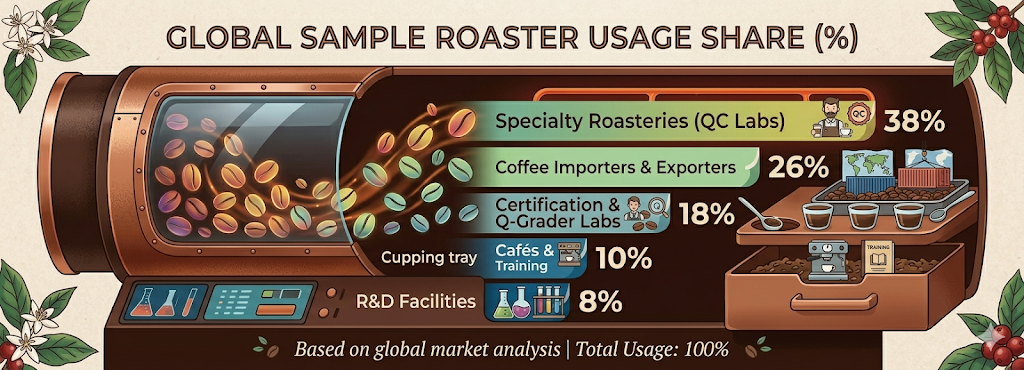
Global Sample Roaster Usage Share (%)
Standard Coffee Cupping Bowls
Cupping bowls form the foundation of every tasting session. The Speciality Coffee Association (SCA) recommends using identical bowls that hold between 7 to 9 ounces (approximately 200–250 ml) of liquid. Coffee Pro Direct’s cupping bowls meet SCA size standards. Uniformity ensures each sample cools at the same rate. This allows fair, unbiased comparison across all lots. When choosing cupping bowls, consider thermal stability and material. High-quality ceramics and tempered glass are preferred because they retain heat and do not impart any unwanted flavours. A smooth, rounded interior allows coffee crusts to form naturally during steeping, making it easier to break them later for aroma evaluation. Consistency in bowl size, material, and colour helps tasters focus on the coffee itself, not environmental differences.
Industry-standard cupping follows a strict ratio of 8.25g coffee per 150ml water, with a grind size optimized for uniform extraction. The crust is typically broken at 4 minutes, and tasting begins once the sample cools to approximately 70°C. Even minor deviations in these parameters can significantly alter sensory perception and scoring accuracy.
A professional cupping setup includes:
- Precision grinders for uniform particle size distribution
- Digital scales with 0.1g accuracy
- Standardized ceramic or glass cupping bowls (200–250 ml)
- Temperature-controlled kettles (±1°C accuracy)
- Dedicated cupping spoons designed for aeration consistency
- Controlled cupping tables with neutral lighting environments
These tools ensure reproducibility across multiple tasting sessions and operators.
| Equipment Type | Function | Precision Impact |
|---|---|---|
| Digital Scale | Coffee dosing | ±0.1g accuracy |
| Cupping Bowl | Thermal consistency | Uniform cooling |
| Grinder | Particle size control | Extraction variance ±15–25% reduction |
| Kettle | Water temperature control | ±1°C stability |
| Spoon | Sensory delivery consistency | Flavor aeration control |
Cupping Spoons: Tools of Precision
The cupping spoon is the most personal tool in a cupper’s kit. Its design, deep and round with a polished interior, allows tasters to slurp coffee efficiently, aerating it across the palate to reveal subtle flavor notes. Professional tasters often prefer silver-plated spoons because they offer a clean surface and reduce metallic interference in taste perception. In busy labs, it’s important to have multiple spoons available to prevent cross-contamination. Spoons should be washed and sanitized after every session. Some cuppers also dedicate specific spoons to certain origins or roast levels to preserve purity during critical evaluations.
Precision Coffee Lab Grinder
No factor affects cupping consistency more than grind size. A reliable lab grinder is critical for accurate extraction. Uneven particle size leads to inconsistent results. It is one of the highest impact tools in any cupping setup. Burr grinders, especially flat burr models, are the gold standard for cupping because they produce uniform particle sizes. Uneven grinds can lead to over- or under-extraction, distorting flavor balance. Modern lab grinders are designed with micrometric adjustment, allowing fine-tuning for each roast type. Some professional cupping labs use dedicated grinders for sample roasting and cupping to prevent cross flavor contamination. In 2025, advanced models with digital interfaces and burr temperature control are becoming popular, offering ultimate repeatability and precision.
Digital Coffee Scales for Accurate Measurement
Precision begins with measurement. Digital coffee scales are used to weigh both ground coffee and water, ensuring a consistent ratio across samples. Even minor deviations can affect the final brew, so scales with high accuracy (0.1g sensitivity) are essential. Professional labs often use waterproof, fast-response scales capable of tracking both time and weight simultaneously. A clear display and easy calibration are also key. When paired with standardised dosing cups, digital scales make it easier to maintain control and repeat results: two of the most important principles in any cupping environment.
Water Kettles and Temperature Control
Water temperature consistency defines extraction quality. For professional cupping, kettles with digital temperature control are indispensable. The ideal temperature range lies between 92°C and 96°C (197°F–205°F), depending on roast degree and altitude. A gooseneck kettle allows precise pouring control, ensuring even saturation during the initial wetting stage. In larger labs, operators use automated multi-kettle setups or thermostatic tanks to handle multiple cupping sessions efficiently. They always ensure that water is filtered and free from unwanted minerals, as water composition directly affects flavor perception.
Sample Trays for Organisation
Professional cupping involves multiple samples at once, and organisation is critical. Coffee sample trays, available in stainless steel, ceramic, or durable plastic-help categorise and manage roasted or green coffee samples during sessions. They prevent mixing, minimise spillage, and provide a clean presentation for evaluation. At Coffee Pro Direct, sample trays are designed for ergonomic use and easy cleaning. Their shape supports optimal visibility of beans, making them ideal for quality grading and defect identification before roasting or cupping.
Spittoons and Waste Bowls
During cupping, tasters spit rather than swallow to prevent caffeine overload and palate fatigue. A professional cupping station requires a high capacity spittoon. It must be easy to sanitize and resistant to corrosion. Stainless steel models are the preferred choice in professional labs. Stainless steel or ceramic spittoons are ideal, offering both hygiene and durability. Large coffee labs typically place several spittoons around the table, ensuring easy access for all participants. A lid or funnel design can also reduce splashes and maintain a cleaner workspace.
Cupping Tables and Lab Setup
The cupping table is more than furniture it structures the entire workflow. As Perfect Daily Grind explains, a well-designed cupping lab directly improves result consistency. Equipment layout and ergonomics affect how cuppers perform across long sessions. Tables should be circular or oval to allow tasters to move easily around samples. Adjustable height designs enhance comfort, especially during long sessions. A non-reflective surface helps maintain visual focus on the coffee without distraction. Professional setups often include color-neutral lighting and quiet environments to allow concentration on sensory cues. Cupping tables from Coffee Pro Direct are built to meet international standards, providing stability, ergonomic design, and durability for heavy use in labs and training centers.
Hygienic Practices for Professional Cupping
Cleanliness defines professionalism. Operators thoroughly clean and dry every piece of equipment after each session. Residual coffee oils can oxidize and create off-flavors. They use food-safe sanitizers and microfiber cloths to maintain hygiene without chemical interference.
In modern labs, teams sometimes use disposable paper filters or protective mats under cups to catch spills and simplify cleanup. By following a consistent cleaning routine, they preserve result integrity and extend the lifespan of their cupping tools.
Advanced Equipment for Modern Coffee Labs
The coffee industry is evolving rapidly, and so is cupping technology. Some labs now incorporate moisture analyzers and data logging systems. These connect sensory feedback with measurable physical parameters. The Sample PRO 100 Roaster adds trial roasting capability to complete the workflow. These tools allow roasters to correlate sensory impressions with objective data, improving quality control and traceability. High-end cupping equipment including automated sample roasters is now standard in 2025. The Coffee Quality Institute requires advanced lab setups for Q Grader certification. Professional tools are no longer optional for credible evaluation environments. These tools bridge the gap between sensory perception and scientific precision, bringing innovation to traditional coffee evaluation methods.
Step-by-Step Coffee Cupping Process
To achieve consistent results, follow a structured cupping process.
- Weigh the samples: Use 8.25g of coffee for every 150ml of water (as per SCA standards).
- Grind the coffee: Use a medium-coarse setting; ensure even particle size.
- Smell the grounds: Assess fragrance before adding water.
- Add hot water: Pour at 93°C and start timing.
- Break the crust: After four minutes, stir gently and inhale the aroma.
- Clean the surface: Remove floating grounds and foam.
- Taste and evaluate: Once cooled to around 70°C, slurp coffee and note attributes such as aroma, acidity, sweetness, and aftertaste.
Consistency in each step is vital. Small deviations can drastically change the perception of flavour and mouthfeel.
Choosing the Right Coffee Cupping Equipment for Your Lab
When selecting equipment for your lab, consider these key factors: 1. Consistency: Choose equipment that ensures repeatable performance. 2. Durability: Industrial-grade materials withstand heavy use. 3. Ease of cleaning: Look for smooth, non-porous surfaces. 4. Accuracy: Digital precision tools improve reliability. 5. Ergonomics: Comfort enhances productivity during long sessions. At Coffee Pro Direct, each piece of cupping equipment is designed with these priorities in mind. Their range of tools supports both small-batch labs and industrial operations, helping coffee professionals achieve perfect calibration and repeatable results every time.
In 2025, advanced cupping labs are increasingly integrating:
- Digital roast tracking systems
- Moisture meters for green coffee analysis
- Refractometers for extraction measurement
- Data logging platforms for sensory mapping
This integration bridges sensory evaluation with measurable chemical and physical data, improving decision accuracy.
Why Choose Coffee Pro Direct
For over sixteen years, Coffee Pro Direct has partnered with coffee roasters, producers, and quality labs across the globe to provide professional-grade equipment for every stage of coffee processing. From sample roasters and cupping tables to precision grinders and moisture analyzers, Coffee Pro Direct delivers complete lab solutions. Our PRO Solutions team helps design and configure your entire setup. Every tool is chosen to work together from day one.
Coffee Pro Direct has built a reputation for reliability, innovation, and technical expertise. Customers across Europe, the UK, Canada, and the United States trust their equipment, especially in regions where quality control and consistency matter most. Choosing Coffee Pro Direct means investing in equipment engineered for precision, durability, and performance. They dedicate themselves to research and customer support, ensuring that every lab receives the best tools to enhance productivity and accuracy in coffee evaluation.
Maintaining and Calibrating Cupping Equipment
Regular calibration guarantees the reliability of your results. Scales, thermometers, and grinders must be tested periodically to ensure they meet standards. Using reference weights, temperature probes, and grind uniformity checks can help identify inconsistencies early. Equipment should be serviced according to manufacturer guidelines. Replacement of worn burrs, recalibration of sensors, and periodic inspection of electrical components help maintain long-term accuracy. Preventive maintenance minimises downtime and protects your investment in high-quality coffee cupping equipment.
Setting Up a Professional Coffee Cupping Lab
A well-designed cupping lab encourages workflow efficiency and focus. Start by allocating separate zones for roasting, grinding, cupping, and cleaning. Coffee Pro Direct’s lab module organizes all tools in one professional workspace. Browse the full lab equipment range to plan your complete setup. Good ventilation is necessary to remove smoke and aroma buildup. Maintain consistent lighting with a neutral color temperature around 5000K for accurate visual assessment. For training environments, provide multiple cupping stations to accommodate groups. Each workstation should have easy access to water, scales, timers, and spittoons. Investing in proper furniture, layout, and safety standards ensures that your lab remains both productive and compliant with international cupping standards.
A structured coffee lab workflow integrates roasting, cupping, and quality control into a continuous loop. A sample divider prepares representative portions from each green coffee lot. Sample roasters then define roast profiles for each prepared portion. Cupping sessions evaluate those profiles and feed results back into roasting decisions. Results feed back into roasting adjustments, creating a closed-loop system that improves consistency and product development efficiency.
Common Mistakes to Avoid in Coffee Cupping
Even experienced professionals can fall into habits that affect results. Avoid these common errors:
- Using inconsistent grind sizes – leads to uneven extraction.
- Skipping water calibration – affects temperature accuracy.
- Mixing bowls of different materials – creates thermal inconsistency.
- Tasting too early or too late – coffee temperature affects perception.
- Ignoring cleaning routines – residue can alter flavor.
Adhering to a disciplined routine ensures reliable results and helps maintain the integrity of your coffee assessments.
Conclusion
Coffee cupping is the cornerstone of coffee quality assurance, and the precision of that process depends on using the right tools. Investing in high-quality coffee cupping equipment not only enhances accuracy but also demonstrates professionalism and commitment to excellence. From grinders and bowls to spittoons and tables, every detail contributes to a better understanding of the coffee’s sensory identity. With trusted suppliers like Coffee Pro Direct, professional coffee labs gain access to equipment engineered for precision, durability, and performance. As the coffee industry continues to evolve in 2025, having the right tools and partners will be the key to maintaining consistent standards and delivering the highest quality in every cup.
Browse our Sample Pro 100 Roaster today
Let us help you build the perfect lab for your needs