
Roasting equipment is the backbone of every successful coffee operation, whether it is a small speciality café, an expanding roasting brand, or a large-scale commercial facility. The roasting stage is where green coffee beans are transformed into aromatic, flavorful roasted coffee, and this transformation depends entirely on the quality and precision of the equipment being used. Without reliable roasting equipment, it is impossible to maintain consistency, control flavour development, or scale production efficiently.
Professional coffee roasting equipment plays a crucial role in maintaining quality and consistency in the specialty coffee industry. As global coffee consumption continues to rise, more businesses are investing in advanced roasting systems that provide better temperature control, airflow management, and repeatable roasting profiles. The growing demand for specialty coffee has significantly increased the need for reliable roasting equipment across cafés, micro-roasteries, and industrial roasting facilities.
As the coffee industry becomes more competitive, customers expect consistent flavour, quality, and transparency. Modern roasting equipment is designed not only to roast coffee but also to provide data, repeatability, and operational efficiency. This guide covers roasting equipment types, selection criteria, and maintenance. It explains why Coffee Pro Direct is trusted by 700+ professionals across 50+ countries.
What Is Roasting Equipment?
Roasting equipment refers to the machines and systems used to apply controlled heat to green coffee beans, thereby developing flavour, aroma, and colour. These machines are engineered to regulate temperature, airflow, time, and bean movement throughout the roasting cycle. The main objective of roasting equipment is to ensure even roasting and repeatable results across every batch.
Professional roasting equipment includes advanced control systems, accurate temperature sensors, airflow regulation mechanisms, cooling systems, and data recording tools. Together, these elements allow coffee professionals to refine roast profiles and maintain consistent quality at any production scale.
The Importance of Roasting Equipment in Coffee Quality
Flavour Development and Control
Coffee flavour is created through complex chemical reactions that occur when beans are exposed to heat. Roasting equipment controls the speed and intensity of these reactions. Precise temperature management allows roasters to enhance sweetness, preserve acidity, and balance bitterness. High-quality roasting equipment enables roasters to unlock the full potential of each coffee origin.
Consistency Across Production
Consistency is crucial for establishing customer trust and maintaining a strong brand identity. Professional roasting equipment allows roasters to replicate the same roast profile across multiple batches. This ensures that customers experience the same flavour every time they purchase a coffee.
Operational Efficiency
Efficient roasting equipment reduces energy consumption, shortens roast cycles, and improves workflow. This efficiency helps businesses increase output while maintaining quality, directly impacting profitability and scalability.
Global Coffee Roasting Operations by Business Type
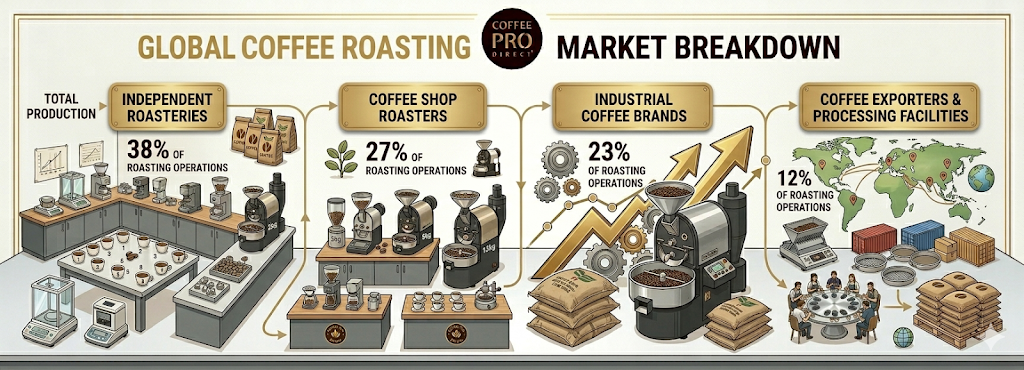
Source: SCA Market Research / ICO
Independent roasteries and specialty coffee shops represent a large portion of global roasting activity, highlighting the increasing importance of professional roasting equipment for small and medium-scale businesses.
Types of Roasting Equipment
| Roaster Type | Heat Transfer Method | Typical Use |
|---|---|---|
| Drum Roaster | Conduction + convection | Specialty roasteries |
| Hot-Air (Fluid Bed) Roaster | Convection | Light roast production |
| Hybrid Roaster | Combination heating | Precision roasting labs |
| Industrial Continuous Roaster | Continuous heat system | Large commercial roasting |
These roasting systems are designed to suit different production scales, from small artisan roasting operations to large industrial coffee processing facilities.
Drum Roasting Equipment
Drum roasting equipment uses a rotating drum to roast coffee beans through a combination of conduction and convection heat. The rotation ensures even exposure to heat and allows for gradual, controlled roast development. Drum roasters are widely used in professional environments due to their stability and versatility.
Drum roasting equipment suits a wide range of roast levels. It’s ideal for specialty cafés, commercial roasteries, and industrial operations. Coffee Pro Direct’s full drum roaster range covers 1kg to 120kg per batch. Its predictable performance makes it a preferred choice for long-term production.
Air Roasting Equipment
Air roasting equipment roasts coffee beans by suspending them in a stream of hot air. Heat transfer occurs rapidly and evenly, resulting in faster roast times. This roasting method is often associated with clean and bright flavour profiles.
Air roasting equipment is particularly effective for light and medium roasts. It is commonly used by speciality coffee professionals who focus on clarity and acidity in their coffee.
Hybrid Roasting Equipment
Hybrid roasting equipment combines the characteristics of drum and air roasting systems. It uses a rotating drum while incorporating controlled airflow to enhance heat transfer and precision.
This type of roasting equipment offers flexibility, allowing roasters to adapt their approach based on coffee type and desired flavour outcome. Hybrid systems are well-suited for businesses that roast a wide variety of coffees.
Industrial Roasting Equipment
Industrial roasting equipment handles high-volume coffee production. These machines process large batch sizes and support continuous operation while maintaining consistent quality.
Industrial roasters include automation features. Coffee Pro Direct’s CM60 (240 kg/hr) and CM120 (480 kg/hr) include PLC touchscreen and SCADA integration as standard. Both use Pre-Mix Blower Burners. Both cool in ~3 minutes. Manufacturers build them for durability and long-term performance, making them essential for large commercial roasting facilities.
Electric Roasting Equipment
Electric roasting equipment uses electric heating elements rather than gas burners. These systems provide precise temperature control and cleaner operation, making them suitable for indoor environments.
Electric roasters are increasingly popular among speciality coffee businesses and coffee labs due to their efficiency, low emissions, and accurate heat management.
Core Components of Roasting Equipment
Roasting Chamber Design
The roasting chamber is the core of every coffee roaster. It heats and agitates coffee beans while controlling how heat and airflow move throughout the roast cycle. Chamber design directly affects roast uniformity, flavour clarity, bean expansion, and development consistency.
Manufacturers engineer professional roasting chambers to balance conductive, convective, and radiant heat transfer. Drum thickness, drum speed, perforation design, and airflow configuration all influence how evenly beans absorb heat during roasting. A well-designed chamber prevents scorching, tipping, and uneven colour development while improving batch repeatability.
Many advanced systems also include adjustable airflow controls, insulated drum construction, and high-efficiency exhaust management to improve thermal stability and energy efficiency. These features help operators maintain precise control throughout critical roast stages such as drying, Maillard reaction, and first crack.
Heating Systems
The heating system supplies energy to the roasting chamber and heavily influences roast responsiveness, control precision, and operational efficiency. Gas systems provide rapid heat adjustments and strong thermal momentum, making them popular among specialty coffee roasters who want dynamic roast control and faster batch recovery.
Electric systems deliver stable, highly precise heat application with cleaner installation requirements and lower maintenance complexity. Modern electric roasters often integrate digital temperature management, programmable roast profiling, and automated control systems that improve consistency across batches.
The choice between gas and electric heating affects roasting style, production workflow, energy consumption, infrastructure requirements, and long-term operating costs. Many professional roasting operations select heating systems based on production volume, local utility availability, ventilation requirements, and desired roast flexibility.
Cooling Systems
Cooling systems rapidly lower bean temperature immediately after roasting to stop roast development at the exact target point. Fast cooling protects flavour clarity, preserves aroma compounds, and prevents residual heat from pushing the roast darker after discharge.
Professional coffee roasters use dedicated cooling trays with powerful airflow systems and agitator arms to cool beans evenly and efficiently. Effective cooling systems typically reduce bean temperature within a few minutes, helping maintain roast consistency across production batches.
Well-designed cooling mechanisms also improve workflow efficiency by preparing the roasting system for the next batch more quickly. In commercial environments, reliable cooling performance plays a major role in maintaining production speed, cup quality, and repeatable roast results throughout continuous roasting sessions.
Control Panels and Software
Modern roasting equipment features digital control panels that allow real-time monitoring and adjustment of roast parameters. Advanced software like Artisan enables data logging and profile storage. Cropster integration is available as an optional upgrade on CM6 and above.
How to Choose the Right Roasting Equipment
When selecting roasting equipment, coffee professionals must evaluate several technical and operational factors. These include roasting capacity, energy efficiency, airflow control, drum design, and automation features. Properly selected equipment allows businesses to maintain consistent roasting profiles while scaling production as demand grows.
Assessing Production Requirements
Selecting roasting equipment begins with understanding your production volume and business goals. Small operations start with the CM1 (4 kg/hr) or CM3 (12 kg/hr). Growing businesses move to the CM6–CM30. Export scale needs the CM60 or CM120.
Choosing the correct capacity also helps businesses avoid underproduction, excessive energy use, and unnecessary operational costs. Many successful roasteries select equipment that supports both current demand and projected growth, allowing smoother scaling without immediate reinvestment in larger systems.
Aligning Equipment with Coffee Style
Different roasting equipment produces different flavor characteristics. Businesses focused on specialty coffee often prioritize control and flexibility, while commercial operations may focus on speed and efficiency.
Drum design, airflow management, burner responsiveness, and software integration all influence roast development and cup profile. Specialty roasters often seek equipment that allows fine adjustments for origin expression, while high-volume operations prioritize repeatability and throughput consistency.
Facility and Infrastructure Planning
Roasting equipment requires adequate ventilation, electrical capacity, and space. Coffee Pro Direct provides downloadable installation layout PDFs for all models. Local compliance varies refer to your national food and safety authority guidelines when planning your setup.
Operators must also consider exhaust routing, afterburner requirements, workflow movement, green coffee storage, and cooling airflow when designing a roasting facility. Proper infrastructure planning improves safety, production efficiency, and long-term operational reliability.
Evaluating Long-Term Value
High-quality roasting equipment represents a long-term investment. Durable machines with advanced features typically provide better performance, lower maintenance costs, and longer service life.
Businesses should also evaluate manufacturer support, spare-part availability, software compatibility, upgrade potential, and energy efficiency before purchasing equipment. Reliable long-term support significantly reduces downtime and protects production continuity.
Technology-Driven Solutions
PLC touchscreen automation standard on CM6 and above. Artisan software included on all models. Cropster and SCADA optional. Metal Fiber burners cut emissions by ~50%. Every machine. Every scale.
Modern roasting technology also improves roast profiling accuracy, batch repeatability, and production tracking through real-time data monitoring. Advanced automation allows operators to store roast profiles, monitor environmental conditions, and optimise workflow efficiency across multiple production batches.
Maintenance and Care of Roasting Equipment
Proper maintenance is essential for preserving roasting quality and extending equipment lifespan. Regular cleaning prevents residue buildup, while calibration ensures accurate temperature readings. Scheduled servicing reduces the risk of downtime and protects long-term performance.
Operators should routinely inspect burners, airflow systems, cooling trays, sensors, motors, and exhaust pathways to maintain safe and efficient operation. Preventive maintenance also improves energy efficiency and helps maintain consistent roast quality over time.
The Future of Roasting Equipment
Roasting equipment continues to evolve with advancements in automation, data analytics, and sustainability. Modern systems are designed to improve efficiency, reduce environmental impact, and provide deeper insights into the roasting process.
Manufacturers increasingly integrate AI-assisted profiling, cloud-based roast management, emission-reduction technology, and energy-efficient heating systems into commercial roasters. These innovations help roasting businesses improve consistency, lower operating costs, and meet growing sustainability expectations across the global coffee industry.
Why Choose Coffee Pro Direct
Coffee Pro Direct is a trusted supplier of professional coffee roasters designed for precision, durability, and performance. With 16+ years of experience and 700+ customers in 50+ countries, Coffee Pro Direct provides equipment for every scale. From shop roasters to industrial machines. From lab tools to PRO Solutions turnkey setups. Each professional coffee roaster is selected and engineered to deliver consistent results, operational efficiency, and long-term reliability.
Coffee Pro Direct ships to 50+ countries worldwide, Coffee Pro Direct serves global markets with high-quality roasting solutions and expert support. Businesses partnering with Coffee Pro Direct benefit from industry knowledge, dependable equipment, and a commitment to excellence that supports long-term success.
Global Coffee Roasting Equipment Market
| Metric | Global Value |
|---|---|
| Market size (2023) | $1.84 Billion |
| Market size (2025) | $2.12 Billion |
| Projected market size (2028) | $2.61 Billion |
| Projected market size (2032) | $3.43 Billion |
| CAGR (2024–2032) | ~7.1% |
Source: Grand View Research — Coffee Roaster Market
The growth of specialty coffee culture and the increasing number of independent roasteries worldwide are key drivers behind the expansion of the coffee roasting equipment market. Businesses continue to invest in advanced roasting technologies to improve consistency, efficiency, and product quality.
Conclusion
Roasting equipment is one of the most critical investments in the coffee industry. The right equipment enables precise flavor control, consistent quality, and scalable production. Understanding the different types of roasting equipment and their features allows coffee professionals to make informed decisions.
By choosing reliable, professional-grade roasting equipment and partnering with a trusted provider like Coffee Pro Direct, businesses can ensure long-term success and deliver exceptional coffee to their customers.
→ Explore the full roasting equipment range or get a quote today. Need a complete lab? → Browse lab packages at 10% discount
Let us help you build the perfect lab for your needs