
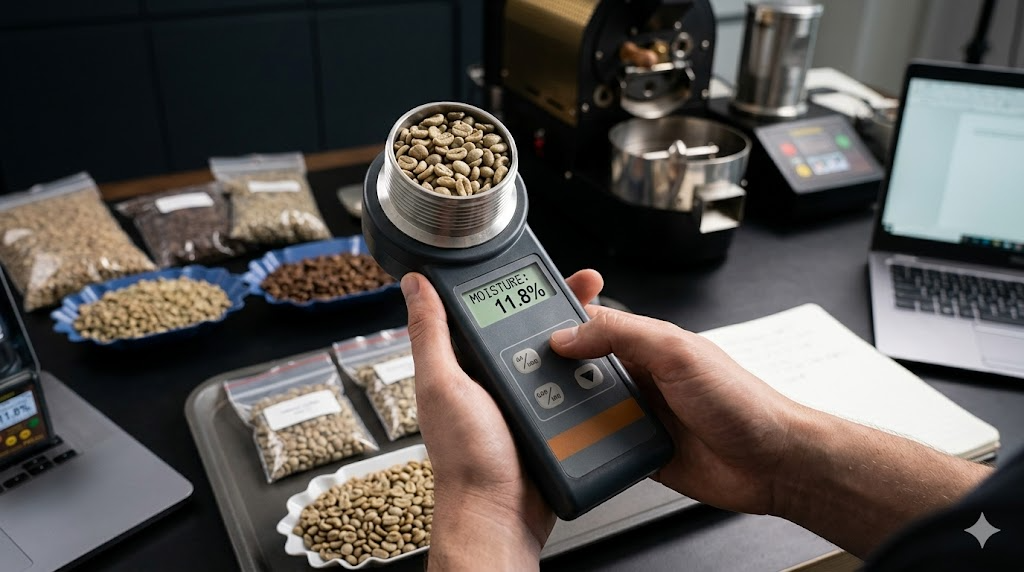
Moisture content is one of the most critical quality parameters in coffee production, directly influencing storage stability, roasting behavior, and final cup consistency. Professional moisture meters for coffee beans allow producers, exporters, and roasters to accurately measure this variable and maintain optimal quality control. In specialty coffee systems, maintaining green bean moisture within the 10–12% range is considered industry standard for stability and consistent roasting performance.
At Coffee Pro Direct, we understand how vital accurate moisture measurement is for producers, exporters, and coffee labs. That’s why we rely on precision tools designed specifically for the unique characteristics of coffee beans. In this guide, we explore the best moisture meters for coffee beans that deliver reliable data for professional use, along with tips on selecting and maintaining them for optimal performance.
The Importance of Measuring Coffee Bean Moisture
Coffee beans are hygroscopic; they absorb and release moisture depending on environmental conditions. This makes monitoring their moisture content essential. Ideally, green coffee beans should have a moisture level between 10% and 12%. If the moisture drops too low, beans become brittle and lose flavour potential. If it rises too high, mould and fermentation risks increase.
Coffee beans are hygroscopic, meaning they absorb and release moisture depending on environmental conditions. If moisture rises above 12%, risks include mold formation and uneven roasting. Below 10%, beans become brittle, leading to reduced sweetness and structural instability during roasting. This narrow control window makes moisture meters essential for quality assurance across the supply chain.
We have found that using accurate moisture meters not only protects coffee quality but also helps us maintain traceability and quality control at every stage, from farm to roastery. Whether you are evaluating green coffee samples or monitoring post-roast storage, having a reliable moisture meter ensures consistent quality results and compliance with international coffee standards.
| Application Area | Usage Share (%) |
|---|---|
| Green Coffee Storage Monitoring | 32% |
| Roasting Quality Control | 28% |
| Import/Export Inspection | 20% |
| Coffee Labs & Certification | 12% |
| Retail QC & Small Roasters | 8% |
What Makes a Good Coffee Moisture Meter
When we evaluate moisture meters for coffee beans, we look for instruments that balance accuracy, speed, and ease of use. The best models can provide a digital readout in seconds, require minimal calibration, and handle both parchment and green coffee samples effectively.
Professional moisture meters used in coffee quality control typically offer ±0.1% to ±0.5% accuracy, with 0.1% resolution for detecting small but meaningful changes in moisture levels. Advanced models include automatic temperature compensation (ATC), multi-calibration profiles, and fast digital response times (5–10 seconds per reading), ensuring reliability in both lab and field environments.
A good meter should offer multi-sample calibration settings, temperature compensation, and a durable design suitable for the demands of coffee labs or field testing. Portable meters are ideal for original use, while benchtop analysers work best for professional lab environments.
| Feature | Basic Meter | Professional Coffee Meter |
|---|---|---|
| Accuracy | ±1% | ±0.1–0.5% |
| Resolution | 1% | 0.1% |
| Temperature Compensation | No | Automatic (ATC) |
| Calibration Profiles | Single | Multi-material |
| Response Time | 15–30 sec | 5–10 sec |
| Data Logging | No | Yes |
How Moisture Affects Coffee Quality
Moisture content directly influences roasting behaviour, storage stability, and final cup quality. Beans with uneven or high moisture levels roast inconsistently, leading to underdeveloped or scorched flavours. During storage, excess moisture can accelerate microbial growth and degrade the bean’s physical integrity.
Moisture levels directly influence roasting behavior. Higher moisture beans require longer drying phases, while low-moisture beans heat faster and risk scorching. Even a 1% deviation in moisture content can significantly alter heat absorption and roast development time, affecting sweetness, acidity, and balance in the final cup.
By integrating moisture testing into our quality control workflow, we prevent flavour loss, preserve aroma compounds, and ensure uniform roasting profiles. This simple step forms the foundation for a consistent, high-quality coffee experience.
Top 5 Moisture Meters for Coffee Beans
We have carefully selected the top five moisture meters for coffee beans based on accuracy, speed, and reliability. Each of these instruments is trusted by professional roasters and cupping labs worldwide for maintaining consistent quality standards.
1. Kett PM-450 Coffee Moisture Meter
The Kett PM-450 is a benchmark for precision in coffee analysis. It’s a portable, battery-operated device that provides instant readings with minimal sample preparation. With its integrated temperature compensation and high repeatability, it’s perfect for lab and field use alike. The PM-450’s digital display delivers results in less than 10 seconds, ensuring efficiency in busy testing environments.
2. Draminski Grain and Coffee Moisture Meter
Designed for agricultural professionals, the Draminski model supports multiple calibration profiles for different coffee types. Its advanced sensor system and rugged casing make it ideal for origin-level testing. We appreciate how easily it handles raw and parchment coffee samples, providing dependable readings under variable humidity conditions.
3. AgraTronix 05100 Portable Coffee Moisture Tester
AgraTronix devices are known for their durability and user-friendly interface. The 05100 model offers a large backlit display, fast measurement capability, and automatic temperature adjustment. It is highly reliable for both warehouse inspections and lab-grade evaluations, making it a popular choice among exporters and large roasters.
4. Wile Coffee Moisture Meter
The Wile Coffee Moisture Meter provides laboratory-grade precision in a compact, handheld unit. Its digital processor ensures high measurement accuracy with minimal variation across samples. It’s an excellent tool for on-site testing, helping users determine bean readiness for transport or roasting with confidence.
5. Sinbo Digital Coffee Moisture Analyser
This analyser combines precision electronics with intuitive controls, making it ideal for lab environments. Its high-resolution sensor system detects even the slightest deviations in moisture percentage. The Sinbo model’s reliability and speed make it a cost-effective solution for small to mid-sized roasters seeking accurate, repeatable measurements.
Calibration and Maintenance of Coffee Moisture Meters
Calibration is key to maintaining accurate readings. We routinely calibrate our meters using standardised reference samples to ensure reliability. It’s also important to clean sensors after each use and store devices in controlled environments to prevent drift. Proper care extends the life of your meter and guarantees consistent results.
Using Moisture Data to Improve Roasting
Once accurate readings are obtained, we integrate moisture data into our roasting profiles. Moisture affects heat transfer during roasting, meaning that drier beans heat faster than those with higher moisture levels. By adjusting charge temperature and roast time accordingly, we achieve more consistent roast curves and flavour outcomes.
Moisture readings are integrated into roasting decisions such as charge temperature, drying time, and development phase control. By standardizing moisture data before roasting, professionals reduce batch variability and achieve more consistent flavor profiles across different origins and processing methods.
Moisture Control During Storage
Even after roasting, moisture management remains crucial. Coffee stored in humid environments can reabsorb moisture, leading to flavour degradation and mould growth. Using air-tight containers, desiccants, and humidity-controlled storage spaces helps preserve coffee freshness and extends shelf life.
Proper storage conditions are essential for maintaining green coffee quality. Moisture fluctuations during storage can lead to fermentation, mold growth, or flavor degradation. Controlled environments using airtight packaging and humidity monitoring help maintain the ideal 10–12% moisture stability range over time.
Role of Moisture Measurement in Coffee Grading
In professional grading environments, accurate moisture measurement supports fair assessment and standardisation. When we evaluate green coffee samples, moisture content serves as one of the primary quality indicators. Consistent readings prevent misjudgment during grading and ensure uniform comparison across lots.
How to Choose the Right Moisture Meter for Your Lab
Selecting the right moisture meter for coffee beans depends on your operational needs. For mobile testing, choose a lightweight handheld model with a fast display. For larger labs, benchtop analysers with advanced calibration features offer greater precision. Evaluate factors like sample size, measurement range, and ease of maintenance before making a purchase.
Integrating Moisture Testing into Quality Control
At Coffee Pro Direct, we include moisture testing as part of our complete quality control workflow. From green coffee intake to final packaging, every step involves data-driven evaluation. Our equipment ensures accurate readings that help us maintain product integrity, reduce waste, and guarantee consistent performance across batches.
Why Choose Coffee Pro Direct
We take pride in providing world-class coffee lab solutions tailored for professionals. Our range of equipment, including moisture meters for coffee beans, is designed for accuracy, durability, and ease of use. We combine years of industry expertise with cutting-edge technology to help you maintain the highest standards in coffee quality. Whether you are managing a commercial roastery, quality lab, or export facility, we deliver reliable tools and support that enhance your workflow and strengthen your results.
| Year | Market Size (USD Billion) | Growth Driver |
|---|---|---|
| 2022 | 1.29 | Specialty coffee expansion |
| 2024 | 1.46 | QC standardization growth |
| 2026 | 2.06 | Lab automation adoption |
| 2030 | 2.13+ | Stable demand |
| 2034 | 3.41 | Long-term industry expansion |
Conclusion
Maintaining coffee quality starts with accurate data, and moisture measurement is at the heart of that process. With the right moisture meters for coffee beans, we can monitor quality, improve roasting consistency, and preserve the distinct character of every batch. At Coffee Pro Direct, we believe that precision equipment and professional insight together create better coffee experiences from origin to cup.
Coffee moisture meters are essential tools in modern coffee quality control systems. By enabling precise measurement of bean moisture content, they help maintain storage stability, improve roasting consistency, and ensure predictable flavor outcomes. For professional coffee operations, moisture measurement is not optional—it is a core requirement for maintaining quality across the supply chain.