
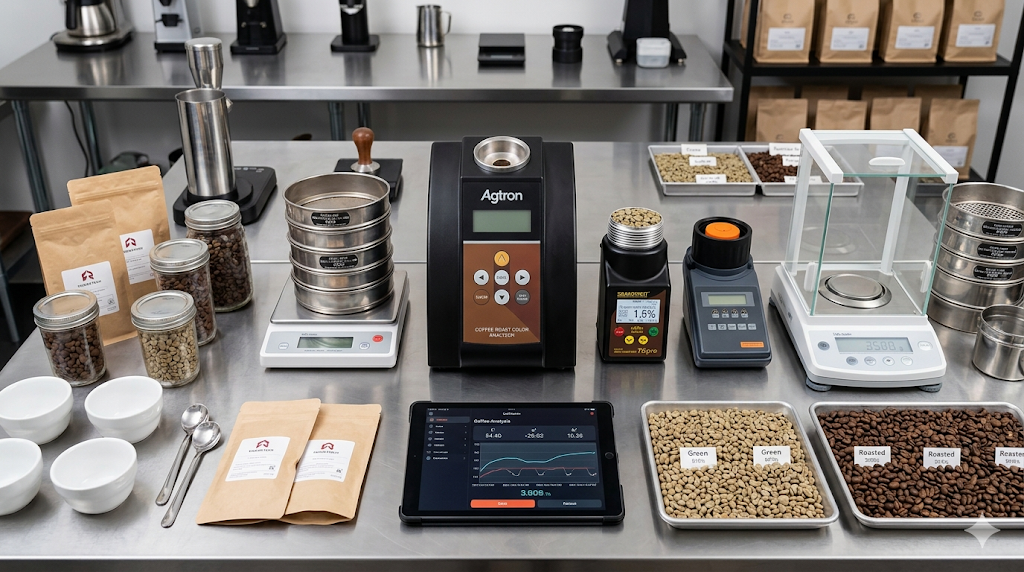
At Coffee Pro Direct, we know that delivering exceptional coffee requires more than just high-quality beans. Coffee quality control equipment is essential for monitoring every stage of production, from green beans to the final roast. With the right tools, we can assess aroma, flavor, moisture content, and consistency, ensuring that each batch meets professional standards. By investing in precise and reliable equipment, we maintain control over the entire process and consistently provide coffee that exceeds expectations.
Importance of Coffee Quality Control Equipment
Maintaining high coffee quality depends on accurate measurement and monitoring. Coffee quality control equipment allows us to identify defects, evaluate flavour profiles, and ensure that moisture and density meet industry standards. Without proper tools, inconsistencies in flavour, aroma, and overall quality can occur. We rely on quality control equipment to preserve the integrity of every batch, reduce waste, and maintain the reputation of our coffee offerings.
Quality control is a fundamental component of modern coffee production. Coffee professionals rely on laboratory tools, sensory analysis, and precision measurement equipment to monitor bean characteristics and ensure consistent flavour profiles. These systems allow roasters to evaluate moisture content, bean density, defects, and roast development before coffee reaches consumers. Implementing structured quality control procedures significantly improves consistency, reduces waste, and maintains professional coffee standards.
Global Coffee Industry Quality Control Metrics
| Coffee Quality Metric | Industry Standard |
|---|---|
| Ideal Green Coffee Moisture Content | 10–12% |
| Global Coffee Production | ~170 Million Bags per year |
| Specialty Coffee Share of Market | ~20–25% |
| Average Coffee Cupping Score for Specialty Coffee | 80+ points |
| Coffee Producing Countries | 70+ |
Source: International Coffee Organization (ICO) / SCA — Specialty Coffee Association
Maintaining these parameters requires advanced quality control equipment such as moisture meters, grading sieves, lab roasters, density meters, and sensory evaluation tools.
Types of Coffee Quality Control Equipment
We use a variety of coffee quality control equipment tailored for different stages of production. This includes moisture analysers, colour sorters, density meters, roasting analysers, and cupping tools. Each type of equipment serves a specific purpose, allowing us to monitor, measure, and refine our processes. By using multiple tools in combination, we ensure that our coffee meets the highest standards from farm to cup. → Explore Coffee Pro Direct’s full lab equipment range
Professional coffee labs use multiple analytical tools to monitor coffee quality across the production chain. Each piece of equipment measures a specific parameter such as moisture, bean density, particle size, or sensory attributes. Together, these tools provide a complete picture of coffee quality from green bean evaluation to final roasting analysis.
Distribution of Quality Control Tools in Coffee Laboratories
| Quality Control Equipment | Role in Coffee Evaluation |
|---|---|
| Moisture Measurement Equipment | 28% |
| Bean Grading & Size Analysis Tools | 22% |
| Sample Roasting & Roast Analysis Equipment | 20% |
| Sensory Cupping Tools | 18% |
| Density & Particle Size Measurement | 12% |
Source: SCA — Specialty Coffee Association Market Research
Because roasting behavior depends heavily on bean moisture, density, and size, these quality control tools are essential for achieving consistent roasting and flavor outcomes.
Moisture Analyzers
Moisture content is critical in coffee quality. Too much moisture can cause mold, while too little can impact flavor development. We use the Moisture Analyzer MAC II delivering accurate readings in just 10 seconds with no internal balance drift and pre-set profiles for green coffee, parchment, and cocoa to measure water content at post-harvest, post-drying, and pre-roast stages. These measurements allow us to adjust drying or storage methods and ensure that every batch achieves optimal moisture levels.
Moisture content directly affects roasting performance, shelf life, and flavour development. Coffee beans with moisture levels above recommended ranges may develop mould during storage, while excessively dry beans can roast unevenly and lose desirable flavour compounds. Accurate moisture analysis allows coffee professionals to adjust roasting profiles and storage conditions for optimal quality.
Coffee Colour Sorters Colour
It is an important indicator of bean quality. We use electronic colour sorters to separate beans based on hue, identifying defects and discolouration. Sorting by colour ensures that only uniform beans reach the roasting stage, improving consistency and overall flavour. Colour sorters also reduce manual labour while providing precise results, which is especially important for large-scale production.
Density and Size Measurement Equipment
Bean density and size affect roasting behaviour and flavour development. We use density meters and sizing equipment to grade beans and separate them into uniform batches. This allows for even roasting and optimal flavour extraction. Monitoring bean size and density also helps us identify defects early and maintain consistent quality across different batches.
Cupping and Sensory Tools
Cupping is a traditional method of evaluating coffee aroma, flavor, and mouthfeel. Our Coffee Sample Trays, Cupping Table, Spittoon, Cupping Bowls, and cupping spoons allow us to assess each batch scientifically to SCA cupping protocol standards. By combining sensory evaluation with technological tools, we can identify subtle differences between origins, roasting profiles, and processing methods. Cupping ensures that every coffee we produce meets the expected quality standards.
Cupping is the internationally recognised method for evaluating coffee aroma, acidity, sweetness, body, and aftertaste. The standardized cupping process removes brewing variables and allows professionals to compare different coffees objectively, making it one of the most reliable tools for coffee quality evaluation.
Roasting Quality Control Equipment
Roasting transforms beans into the coffee we enjoy. We use roasting analyzers, temperature sensors, and the Sample PRO 100 available in 1, 2, 4, or 6 drum configurations with K-type thermocouple and Artisan software integration to monitor roast profiles and replicate successful results at production scale. This equipment allows us to replicate successful roasts and adjust parameters for new batches. Consistent roasting ensures that flavor and aroma remain true to the intended profile, giving customers a premium experience every time.
Grinding and Particle Size Control
Grinding uniformity affects extraction, flavor and consistency. We use the Lab Grinder LSG33 with a stepless dial, 100–1,000μm grind range, and 84mm hardened steel discs alongside particle analyzers to monitor size distribution and achieve optimal results for different brewing and cupping applications.. This equipment allows us to adjust grinding settings to achieve optimal results for different brewing methods. Consistent grinding is essential for both commercial and specialty coffee applications.
Packaging Quality Control Equipment
Even after roasting and grinding, coffee quality must be preserved during packaging. We use vacuum sealing machines, nitrogen-flushing systems, and weight-checking equipment to ensure freshness and accurate portioning. Quality control at this stage prevents oxidation, moisture ingress, and loss of flavour during transport and storage.
Lab Equipment for Coffee Analysis
Our lab is equipped with tools to test chemical composition, acidity, and defects in coffee beans. Spectrophotometers, moisture meters, and other analytical instruments allow us to quantify quality objectively. Laboratory testing supports sensory evaluation and provides data to refine processing, roasting, and storage practices.
Coffee laboratories combine multiple analytical instruments to evaluate bean quality and roasting performance. These tools allow coffee professionals to perform precise measurements and maintain consistent standards throughout the roasting process. Laboratory analysis complements sensory evaluation by providing measurable data on bean properties and roast characteristics.
Coffee Quality Control Laboratory Workflow
| Quality Control Stage | Equipment Used | Purpose |
|---|---|---|
| Green Bean Inspection | Sample Sieves (ISO Ø4–8mm) | Separate beans by size |
| Lot Splitting | Sample Divider (4,000g, 32 channels) | Representative sampling |
| Moisture Measurement | Digital Moisture Meter | Determine water content in 10 seconds |
| Parchment Processing | Parchment Huller S200 | Convert parchment to green bean |
| Sample Roasting | Sample PRO 100 | Test roast profiles |
| Sensory Evaluation | Cupping Table + Cupping Bowls + Spittoon | Evaluate flavour and aroma |
| Sample Archiving | Hand Sealer | Airtight preservation |
| Grinding | Lab Grinder LSG33 | Precision cupping grind |
This workflow enables coffee professionals to detect defects early, refine roasting profiles, and ensure consistent product quality across different batches.
Benefits of Coffee Quality Control Equipment
Using coffee quality control equipment provides numerous advantages. We achieve consistency, reduce waste, and maintain high standards for every batch. Equipment allows us to detect issues early, adjust processes, and ensure that customers receive coffee of premium quality. It also supports experimentation and innovation, allowing us to explore new origins, blends, and roasting techniques.
Selecting the Right Equipment
Choosing the right coffee quality control equipment depends on processing scale, production goals, and quality requirements. We prioritize precision, durability, and ease of use. Small-scale labs benefit from the Moisture Analyzer MAC II, Sample Sieves, Cupping Table, and Sample PRO 100. Larger operations pair these with commercial or industrial roasters and automated sorting systems. Explore lab packages at 10% discount. Selecting appropriate tools ensures that quality standards are consistently met across all operations.
Maintenance and Calibration
Regular maintenance and calibration are crucial for accurate measurements. We clean, inspect, and calibrate all quality control equipment to prevent drift and maintain precision. Routine checks ensure that moisture analysers, roasting sensors, and cupping tools provide reliable data. Proper maintenance reduces downtime and extends equipment lifespan while maintaining consistent coffee quality.
Sustainability in Quality Control
Efficient coffee quality control also supports sustainability. By identifying defective beans early, we minimize waste and optimize production aligned with FAO post-harvest loss reduction guidelines for agricultural commodities, which consistently highlight early-stage QC as the most effective waste reduction strategy. Energy-efficient analytical tools and automated sorting systems reduce resource consumption. Our approach ensures that high-quality coffee is produced responsibly and sustainably, benefiting both the environment and the business.
Training and Education
Coffee quality control equipment is a valuable educational tool. We use it to train staff in sensory evaluation, roasting, and processing standards including in Q-Grader certification programs and professional coffee labs worldwide. Hands-on experience with professional tools develops technical skills and an understanding of coffee chemistry. This training ensures that our team consistently produces coffee that meets or exceeds professional standards.
Integrating Technology with Traditional Methods
While traditional sensory evaluation remains important, integrating technology enhances accuracy and efficiency. Combining cupping, roasting analysis, and moisture measurement allows us to identify issues faster and make informed decisions. Technology complements human expertise, ensuring that every batch reflects both scientific precision and artisanal quality.
Why Choose Coffee Pro Direct
At Coffee Pro Direct, we provide coffee quality control equipment including the Moisture Analyzer MAC II, Sample Sieves, Sample Divider, Sample PRO 100, Lab Grinder LSG33, and full cupping setup that is reliable, precise, and designed for professional use. Build a complete lab through our packages at 10% discount or a full facility via PRO Solutions. Our tools allow us to maintain control over every stage of production, from processing to roasting and packaging. We also offer guidance and support to help clients use equipment effectively. Choosing Coffee Pro Direct means partnering with experts dedicated to producing high-quality coffee consistently.
Conclusion
Coffee quality control equipment is essential for delivering premium coffee. At Coffee Pro Direct, we use advanced moisture analysers, colour sorters, cupping tools, roasting sensors, and lab instruments to maintain consistency, improve efficiency, and ensure every batch meets our high standards. Investing in quality control equipment is an investment in flavour, reliability, and customer satisfaction. By combining technology with expertise, we provide coffee that consistently delights consumers and sets a benchmark in quality.
→ Explore the full quality control equipment range or get a quote today. Building a complete lab? → Browse lab packages at 10% discount
Let us help you build the perfect lab for your needs