
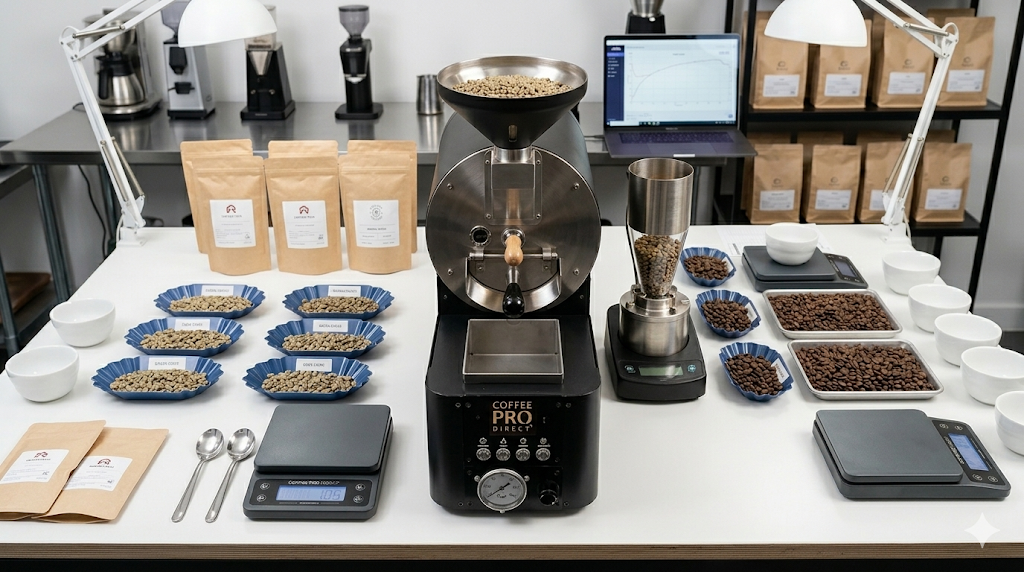
Selecting the right coffee roaster sizes is a critical investment decision that directly impacts production efficiency, roast consistency, and long-term scalability. For most small and medium roasteries, choosing between 1kg, 3kg, and 5kg machines determines not only daily output capacity but also workflow design and business growth potential. With options like 1kg, 3kg, and 5kg models, understanding which capacity best fits our goals helps us invest wisely. At Coffee Pro Direct, we guide roasters worldwide in choosing the ideal size for consistent, high-quality results.
Understanding Coffee Roaster Sizes
Coffee roaster sizes are measured by the weight of green beans roasted per batch. Coffee Pro Direct’s shop roaster range covers 1–6 kg machines for every small-scale need. Matching size to demand ensures efficiency without compromising freshness. A 1kg roaster can handle small experimental batches, while a 5kg model is designed for higher production volumes. The choice depends on business scale, frequency of roasting, and the types of customers we serve. Matching roaster size to demand ensures efficiency without compromising freshness.
In commercial roasting environments, batch size efficiency typically increases by 25–40% when moving from 1kg to 5kg systems due to improved heat retention and reduced cycle frequency.
| Roaster Size Category | Global Usage Share (%) |
|---|---|
| 1kg Sample / Lab Roasters | 38% |
| 3kg Small Commercial Roasters | 34% |
| 5kg Mid-Scale Roasters | 18% |
| 10kg+ Industrial Roasters | 10% |
Source: Roast Magazine industry survey estimates; specialty coffee roasting equipment usage data.
Why Coffee Roaster Sizes Matters
Choosing the correct roaster size isn’t just about production capacity; it affects flavour development, energy efficiency, and workflow. A smaller roaster offers flexibility and control, while a larger one ensures consistent output for wholesale or retail supply. The right balance allows us to maintain both quality and profitability.
Industry data shows that improper roaster sizing can reduce operational efficiency by up to 30%, mainly due to underutilization or overheating cycles in mismatched production environments.
| Performance Factor | 1kg Roaster | 3kg Roaster | 5kg Roaster |
|---|---|---|---|
| Batch Output per Hour | 3–4 kg | 10–12 kg | 18–22 kg |
| Heat Stability | Medium | High | Very High |
| Flavor Control Precision | Very High | High | Medium-High |
| Energy Efficiency | High | Medium | Medium |
| Best Use Case | Labs / cafés | Small roasteries | Commercial roasting |
Source: Specialty Coffee Association roasting reference data; Coffee Pro Direct field performance benchmarks.
1kg Coffee Roaster: Perfect for Small Batches
A 1kg coffee roaster is ideal for small businesses, coffee shops, or labs focused on precision and experimentation. It’s perfect for profiling new green coffee lots, testing roast curves, and producing limited batches. Quick parameter adjustments make it ideal for learning and experimentation. It is also the recommended tool for origin evaluation before scaling. We can quickly adjust parameters to explore different roast profiles, making it a valuable tool for learning and refining our craft.
Globally, 1kg roasters are primarily used in sample profiling, quality control labs, and micro-roasteries where precision outweighs volume, accounting for nearly 40% of installed specialty roasting systems worldwide.
Benefits of a 1kg Roaster
A 1kg machine offers exceptional control over roast development. Its smaller batch size makes it easier to monitor heat transfer and airflow changes. This size is energy-efficient and space-saving ideal for urban cafés and small roasting facilities. It’s an excellent training tool for new roasters. Pair it with the Sample PRO 100 Roaster for a complete small-scale profiling and evaluation setup.
3kg Coffee Roaster: Ideal for Growing Businesses
The 3kg coffee roaster bridges the gap between small-scale experimentation and professional production. It’s designed for roasteries producing moderate volumes or serving multiple cafés. With greater capacity and thermal stability, it offers consistent roast results batch after batch.
A 3kg roaster supports 60–120 kg of daily output depending on roast cycles. It is one of the most widely adopted configurations for small commercial businesses. As Perfect Daily Grind explains, scaling a roastery from café-level to commercial supply often begins at the 3 kg batch size.
Advantages of a 3kg Roaster
A 3kg roaster provides more output without losing the precision needed for flavour consistency. It’s suitable for medium-sized roasteries looking to expand their customer base. We can roast larger quantities while maintaining the flexibility to experiment with new origins or blends.
5kg Coffee Roaster: Designed for Commercial Efficiency
For established roasting businesses, a 5 kg roaster offers professional-grade capacity and performance. When output demands grow beyond this point, Coffee Pro Direct’s commercial roasters (12–30 kg) are the natural next step. Planning for that transition from day one saves time and capital. It allows us to meet wholesale demand while ensuring quality across every roast. Its powerful heating and airflow system maintains even bean development, even during heavy roasting schedules.
At scale, 5kg roasters reduce per-kilogram roasting cost by approximately 15–25% compared to smaller systems due to improved thermal efficiency and reduced batch repetition.
Advantages of a 5kg Roaster
With larger drum capacity, better heat retention, and higher productivity, a 5kg roaster supports growing businesses and a consistent supply. It helps us reduce roasting time per batch and maintain uniform results, making it an ideal choice for commercial operations and roasteries planning to scale further.
Comparing 1kg, 3kg, and 5kg Coffee Roasters
Each roaster size has its strengths and applications. The 1kg model excels at precision and small-batch experimentation, while the 3kg model balances control and capacity. The 5kg machine delivers the output needed for commercial operations. Evaluating roast volume, growth potential, and available space helps determine the most practical choice for our roastery.
Roaster size impacts output and flavor repeatability simultaneously. Smaller machines offer tighter control for experimentation. Larger units prioritize consistency across high-volume batches. The Specialty Coffee Association links batch repeatability to correct equipment sizing as a foundational quality requirement.
| Year | Global Coffee Roasting Equipment Market (USD Billion) | Growth Rate |
|---|---|---|
| 2022 | 1.7 | — |
| 2024 | 2.2 | 6.9% |
| 2026 (Projected) | 2.8 | 6.9% |
| 2030 (Projected) | 3.9 | 6.9% |
Source: Global coffee roasting equipment market projections; Roast Magazine and industry research estimates.
Factors to Consider Before Choosing Roaster Size
When selecting the right roaster coffee roaster sizes matters, we must evaluate our production goals, bean variety, and roasting frequency. We should also consider space requirements, energy supply, and exhaust setup. The decision impacts workflow, cost efficiency, and roast quality over time.
How Roaster Size Affects Flavor Profiles
Coffee roaster sizes influences how heat transfers through the beans. Smaller roasters heat up faster and are more responsive to temperature adjustments, producing lively and complex flavor profiles. Larger roasters retain heat longer, encouraging even caramelization and body development. Matching size to desired flavor outcomes ensures a consistent product.
Roaster size also affects airflow dynamics, batch momentum, and roast stability throughout the development process. Specialty coffee professionals often choose smaller systems for profile experimentation and single-origin clarity, while larger roasters support greater consistency across high-volume production runs.
Production Volume and Business Growth
Our production targets determine the ideal roaster size. A 1kg machine can produce up to 4kg per hour, suitable for small shops. A 3kg unit handles around 12kg per hour, while a 5kg model reaches 20kg or more. Choosing a roaster that matches our projected output prevents unnecessary strain or underutilization.
Selecting the right capacity also supports smoother workflow management, more efficient staffing, and better inventory control. Businesses that plan for future wholesale accounts and expanding customer demand can scale more effectively without needing immediate equipment replacement.
Energy Efficiency and Cost
Larger roasters consume more fuel but deliver economies of scale. Smaller machines are energy-efficient and cost-effective for limited operations. Balancing initial investment and operational efficiency helps ensure sustainable profitability.
Modern roasting systems improve efficiency through insulated drums, advanced airflow control, and energy-saving burner technology. These features reduce fuel consumption, lower operating costs, and help roasting businesses maintain strong production margins over the long term.
Upgrading Roaster Sizes Over Time
As our business grows, upgrading roaster sizes becomes a natural step. Start with a 1 kg or 3 kg model to build experience and customer demand. Move to a 5 kg machine as output requirements grow consistently. From there, commercial roasters (12–30 kg) and industrial roasters (60–120 kg) are the next steps. Our PRO Solutions team helps plan your full scaling pathway from the start.
Why Choose Coffee Pro Direct
At Coffee Pro Direct, we provide expertly designed coffee roasters built to deliver precision, durability, and flavor consistency. Whether you need a 1 kg, 3 kg, or 5 kg machine, our shop roaster range meets every requirement. Support your roaster with a moisture analyzer for green coffee intake testing. Our complete lab equipment range covers every QC step around your roast. We combine advanced engineering with user-friendly controls, ensuring every roast is consistent and repeatable. Our commitment to quality and after-sales support helps roasters achieve their goals with confidence.
Maintenance and Longevity
Proper maintenance extends the lifespan of any roaster. Regular cleaning, exhaust management, and inspection ensure stable performance. At Coffee Pro Direct, we design our machines with easy-access components and durable materials, ensuring long-term reliability.
Routine servicing also improves airflow consistency, burner efficiency, and temperature accuracy while reducing the risk of unexpected downtime. Preventive maintenance protects roast quality and helps commercial roasteries maintain stable production schedules over many years of operation.
Roaster Size and Space Planning
The available workspace determines how efficiently we can install and operate roasting equipment. Compact models like 1kg and 3kg roasters fit smaller areas, while 5kg units require better ventilation and layout planning for safety and workflow efficiency.
Operators must also plan for cooling trays, green coffee storage, exhaust systems, electrical access, and safe movement around the roasting area. Efficient space planning improves workflow, supports compliance requirements, and creates a safer production environment.
The Future of Medium-Sized Roasters
Medium-capacity roasters like the 3kg model are becoming increasingly popular among small-scale speciality roasters. They offer the perfect mix of affordability, capacity, and control, making them ideal for growing businesses focused on quality.
Many specialty coffee brands now use medium-sized roasters to support direct-to-consumer sales, café supply, subscription services, and seasonal microlot programs. Their flexibility allows businesses to scale production gradually while maintaining strong roast consistency and flavour precision.
How We Help Roasteries Scale
We work with clients to assess production capacity, flavour goals, and market demand. By understanding these factors, we recommend the perfect coffee roaster size for efficiency and growth. Our mission is to make the transition between roasting capacities smooth and cost-effective.
We also help businesses evaluate infrastructure requirements, workflow optimisation, software integration, and long-term expansion planning. This consultative approach ensures roasteries invest in equipment that supports both immediate operational needs and future commercial growth.
Conclusion
Choosing between a 1kg, 3kg, or 5kg coffee roaster depends on our business goals, production needs, and flavour preferences. A 1kg roaster suits small labs or cafés focused on experimentation, while a 3kg roaster supports consistent small-scale production. The 5kg model is ideal for established businesses looking to increase output. Coffee Pro Direct provides professional-grade roasters that balance precision, performance, and scalability. Back every roast with a sample divider for representative lot preparation. Evaluate every result at the cupping table for data-backed roast decisions.
Browse our Sample Pro 100 Roaster today
Let us help you build the perfect lab for your needs